percentages infographics
Every InfoGraphHub infographic tagged “percentages”.
 Maths
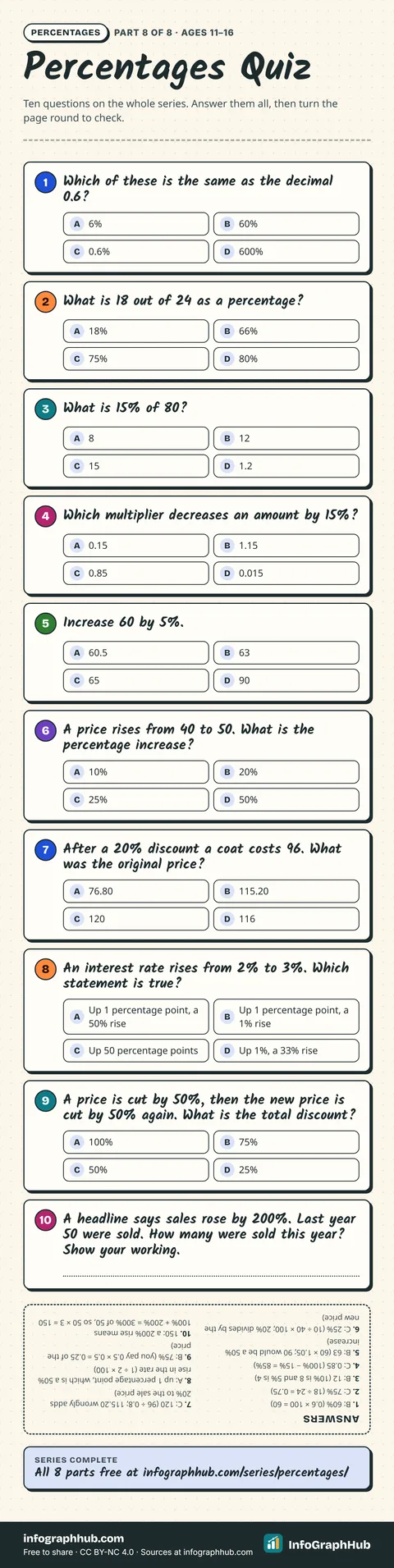
Percentages Quiz: Test Yourself
Ten questions covering the whole percentages series: converting decimals, one amount as a percentage of another, percentage of an amount, multipliers, percentage change, reverse percentages, percentage points, successive discounts and a news headline, with worked answers.
 Maths
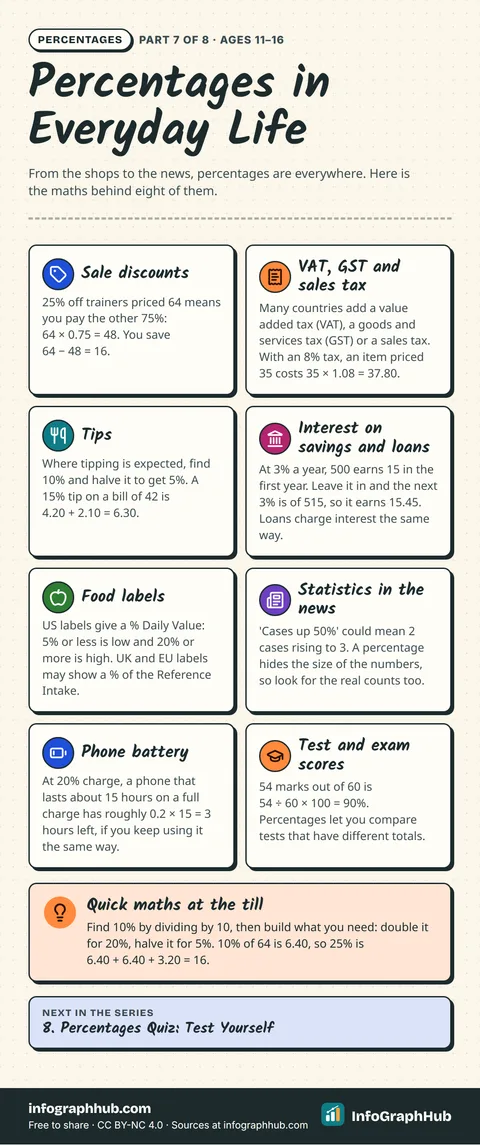
Percentages in Everyday Life: 8 Real Examples
Eight places percentages turn up every day, each with the maths: sale discounts, VAT, GST and sales tax, tips, interest on savings and loans, food labels, statistics in the news, phone battery levels and test scores.
 Maths
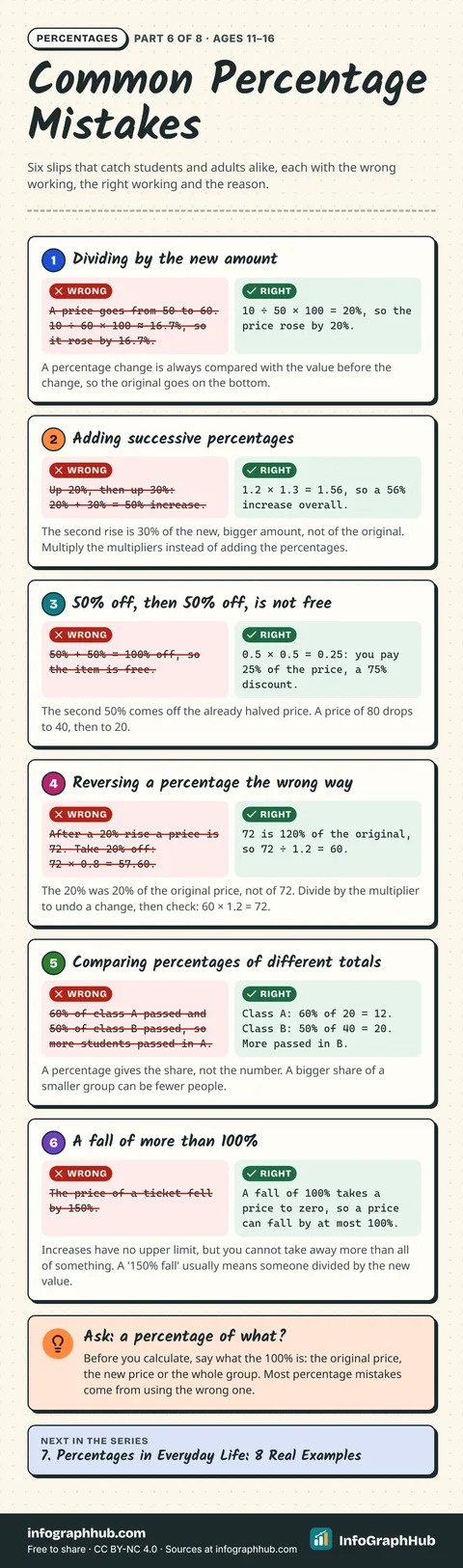
Common Percentage Mistakes and How to Avoid Them
Six common percentage mistakes with the wrong working, the right working and why: dividing by the new amount, adding successive percentages, thinking 50% off twice is free, reversing a percentage the wrong way, comparing different totals and falls of over 100%.
 Maths
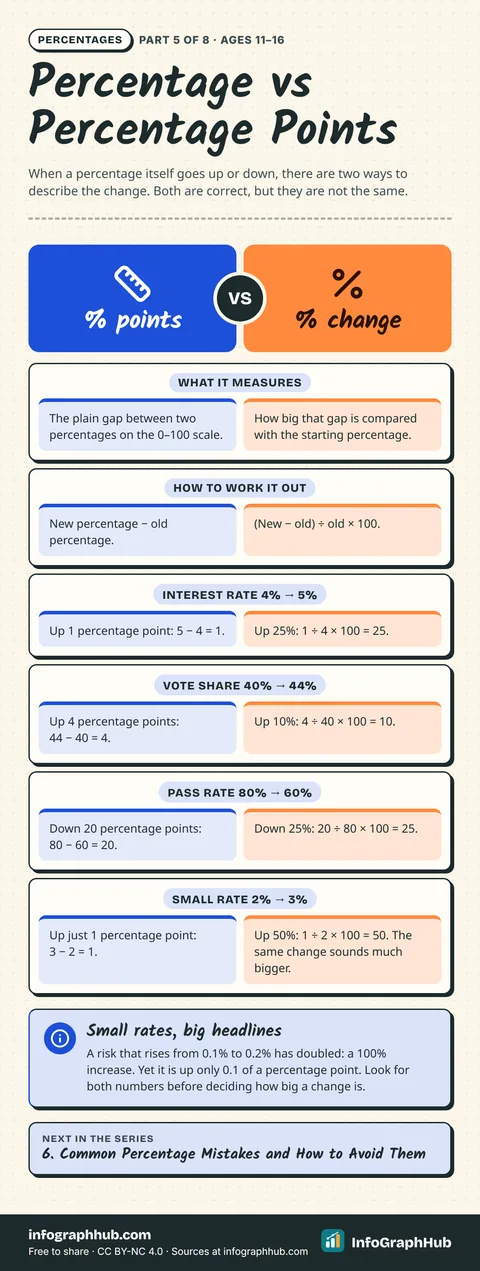
Percentage vs Percentage Points: What Is the Difference?
Percentage points measure the plain gap between two percentages; percentage change compares that gap with where it started. Side-by-side examples: an interest rate from 4% to 5% is up 1 percentage point but 25%, and a vote share from 40% to 44% is up 4 points but 10%.
 Maths
Percentage Change and Reverse Percentages: The Rules
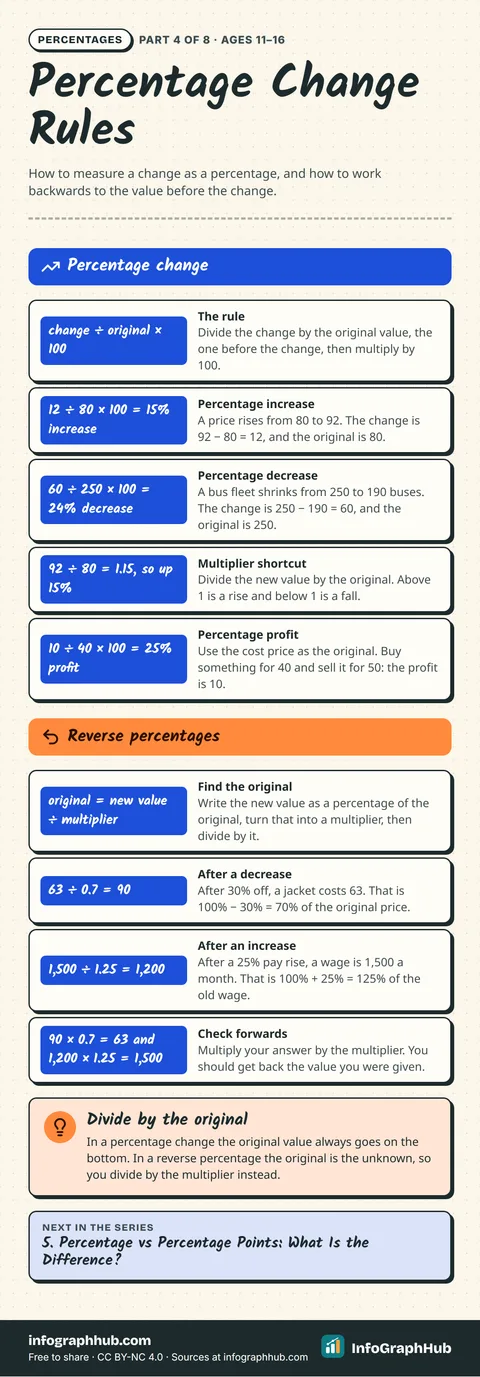
The rules for percentage change and reverse percentages: divide the change by the original and multiply by 100, use new ÷ original as a shortcut, work out percentage profit, and find the value before a change by dividing by the multiplier.
 Maths
Percentage Increase and Decrease: Step by Step
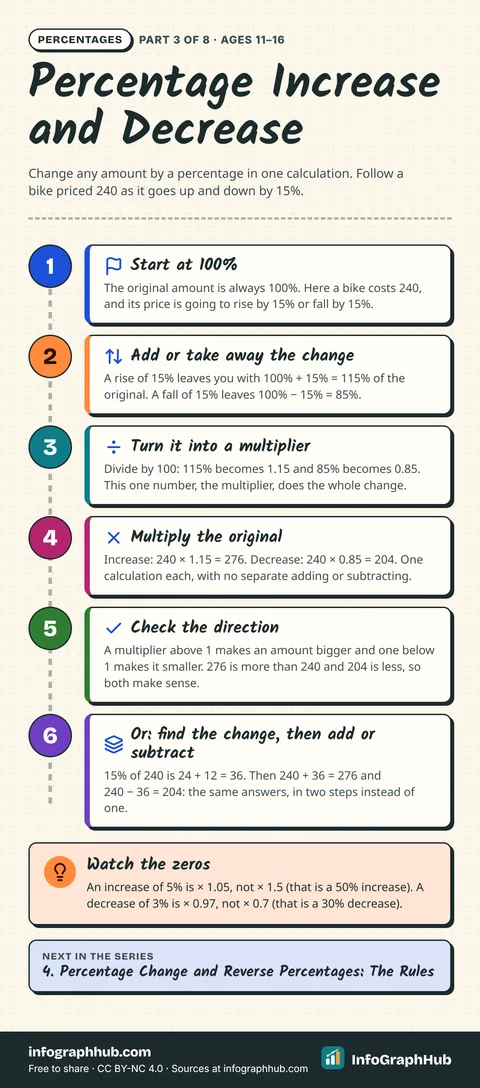
How to increase or decrease an amount by a percentage in one step with a multiplier: start from 100%, add or take away the change, divide by 100 and multiply. Worked through with a price of 240 going up and down by 15% (× 1.15 and × 0.85).
 Maths
Finding a Percentage of an Amount: Worked Examples
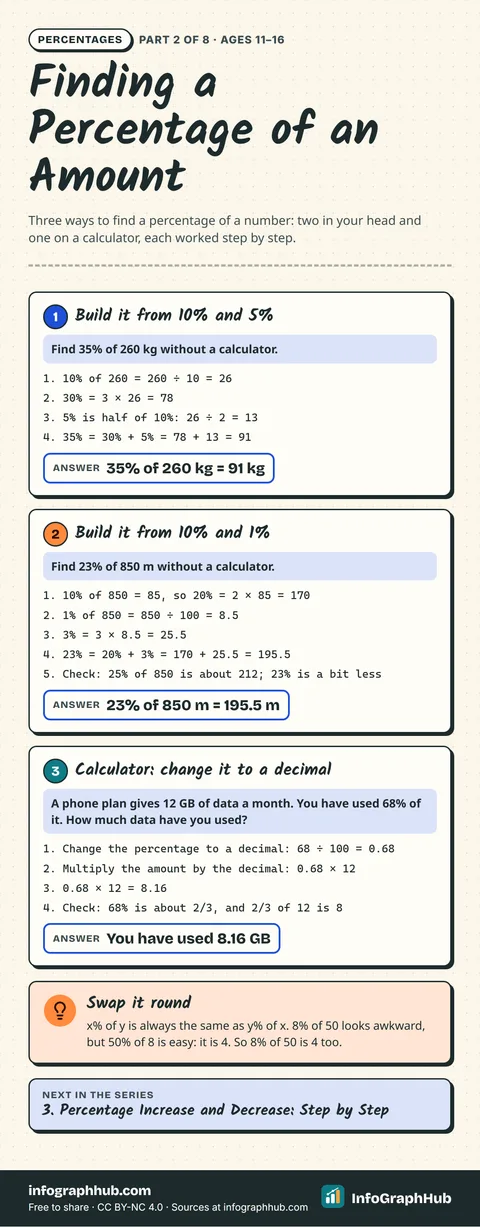
Three worked examples of finding a percentage of an amount: building 35% from 10% and 5% and building 23% from 10% and 1% without a calculator, then the one-step calculator method that turns the percentage into a decimal and multiplies.
 Maths
Fractions, Decimals and Percentages
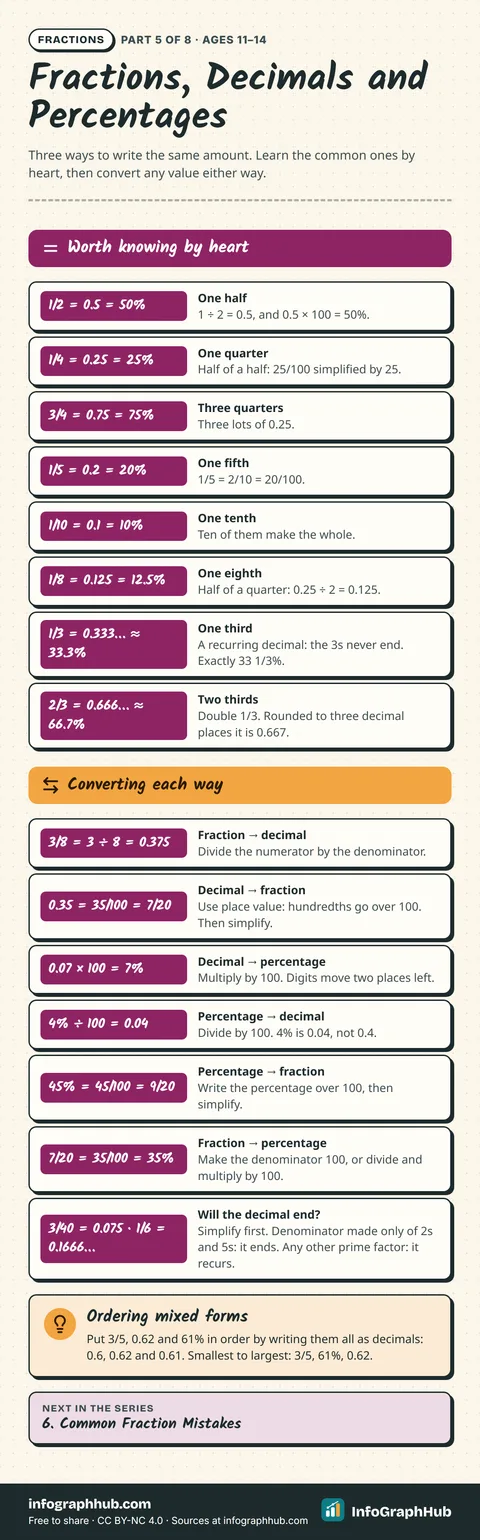
A cheat sheet of the fraction, decimal and percentage equivalents worth knowing by heart, from 1/2 = 0.5 = 50% to 1/3 = 0.333… ≈ 33.3%, plus the six conversions between the three forms and how to tell if a decimal will end.
 Finance
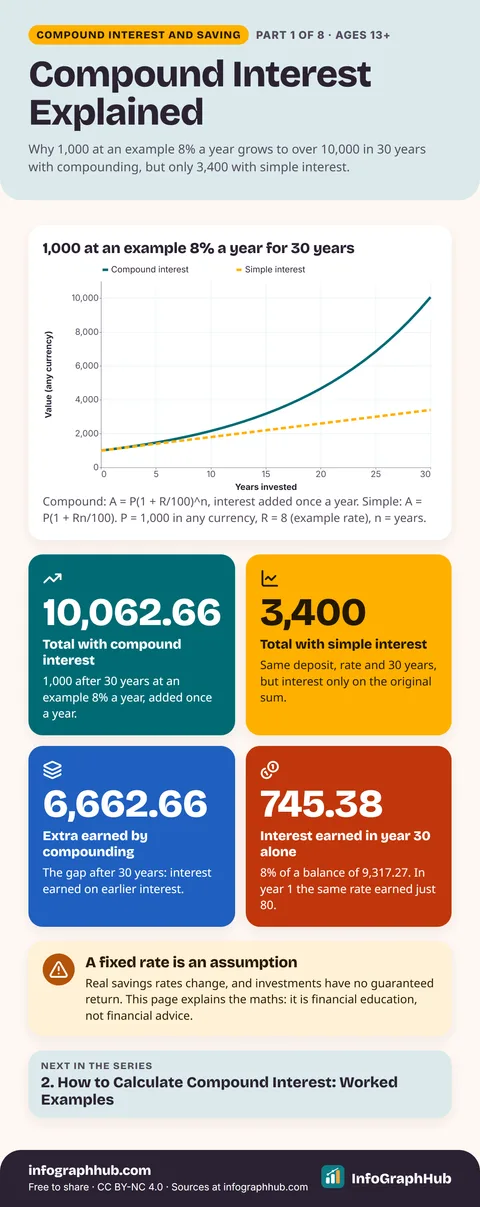
Compound Interest Explained: How Money Grows Over Time
Compound interest is interest earned on interest. Each year's interest joins the balance, so the next year's interest is worked out on a bigger sum. Over 30 years at an example 8% rate, 1,000 grows to 10,062.66, against 3,400 with simple interest.
 Maths
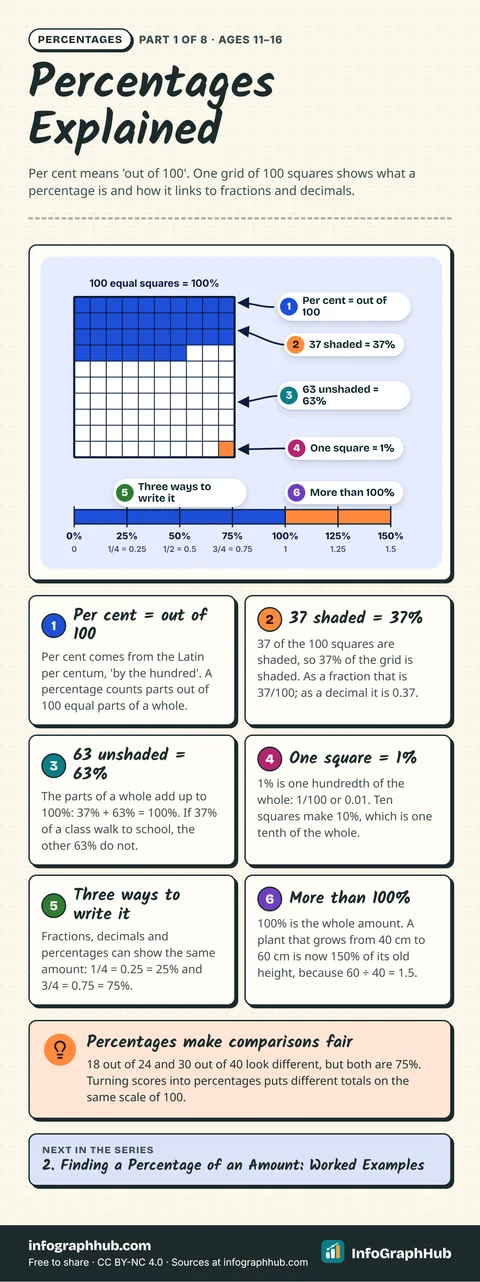
Percentages Explained: What a Percentage Means
What a percentage is, shown on a hundred square: per cent means out of 100, the parts of a whole add up to 100%, 1% is one hundredth, and the same amount can be written as a fraction, a decimal or a percentage, including values above 100%.