MathsComparisonPart 5 of 8, PercentagesUpdated 2 October 2026
Percentage vs Percentage Points: What Is the Difference?
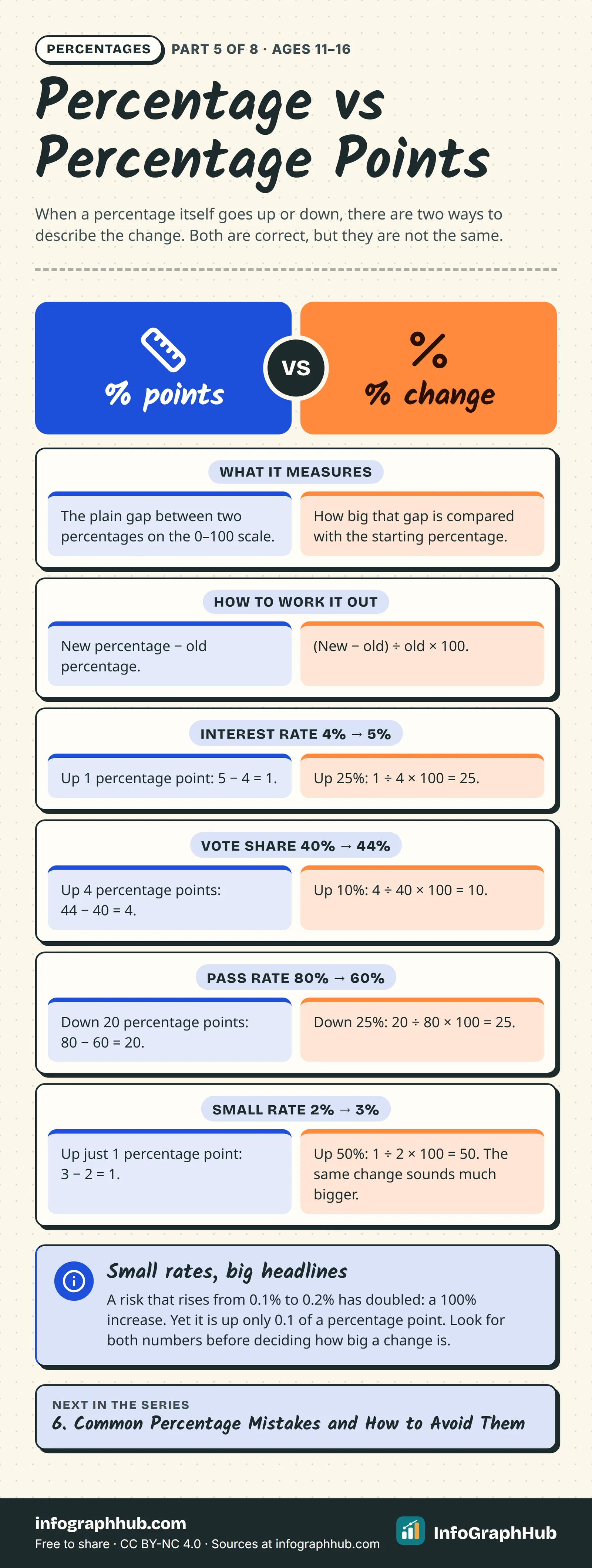
Percentage points measure the plain gap between two percentages; percentage change compares that gap with where it started. Side-by-side examples: an interest rate from 4% to 5% is up 1 percentage point but 25%, and a vote share from 40% to 44% is up 4 points but 10%.
Interactive
Explore it step by step
- What it measures
% points: The plain gap between two percentages on the 0–100 scale.
% change: How big that gap is compared with the starting percentage.
- How to work it out
% points: New percentage − old percentage.
% change: (New − old) ÷ old × 100.
- Interest rate 4% → 5%
% points: Up 1 percentage point: 5 − 4 = 1.
% change: Up 25%: 1 ÷ 4 × 100 = 25.
- Vote share 40% → 44%
% points: Up 4 percentage points: 44 − 40 = 4.
% change: Up 10%: 4 ÷ 40 × 100 = 10.
- Pass rate 80% → 60%
% points: Down 20 percentage points: 80 − 60 = 20.
% change: Down 25%: 20 ÷ 80 × 100 = 25.
- Small rate 2% → 3%
% points: Up just 1 percentage point: 3 − 2 = 1.
% change: Up 50%: 1 ÷ 2 × 100 = 50. The same change sounds much bigger.
Use this infographic
Free under CC BY-NC 4.0, with credit to InfoGraphHub.
Two ways to describe one change
Some numbers are percentages already: interest rates, exam pass rates, vote shares, unemployment rates. When one of them changes, there are two ways to describe the change, and both are correct:
- In percentage points, the plain difference between the two percentages.
- As a percentage change, the difference compared with the starting percentage.
The trouble starts when people mix them up, or use the word "per cent" for both.
Percentage points: the plain gap
To find the change in percentage points, subtract. An interest rate that rises from 4% to 5% has gone up by 5 − 4 = 1 percentage point. A pass rate that falls from 80% to 60% has gone down by 20 percentage points. Nothing is divided: you are measuring the distance between two positions on the same 0–100 scale. In reports, percentage points are sometimes shortened to pp.
Percentage change: compared with the start
A percentage change uses the usual rule, change ÷ original × 100, even though the values are themselves percentages. The rate that went from 4% to 5% rose by 1 ÷ 4 × 100 = 25%: the rate is a quarter bigger than before. The pass rate that fell from 80% to 60% fell by 20 ÷ 80 × 100 = 25%.
So "the interest rate rose by 1%" is ambiguous. It might mean 4% → 5% (one percentage point) or 4% → 4.04% (a 1% rise in the rate). Saying "percentage points" removes the doubt.
Why it matters in the news
The difference is biggest when the starting percentage is small. If the chance of a side effect rises from 0.1% to 0.2%, it has doubled, a 100% increase, which sounds alarming. In percentage points it has risen by only 0.1, or one extra case in every 1,000 people. Both statements are true, and a careful reader wants to see both.
The same applies to elections. A party whose vote share rises from 40% to 44% can say it gained 4 points, or that its share grew by 10%.
Comparing two groups
Percentage points are also used to compare two rates at the same time. Eurostat, the EU statistics office, gives an example: in 2022, 85.9% of women and 81.4% of men aged 20–24 in the EU had at least an upper secondary education. The gap is 85.9 − 81.4 = 4.5 percentage points. As a percentage of the men's rate the women's rate is about 5.5% higher, because 4.5 ÷ 81.4 × 100 ≈ 5.5.
Basis points
In finance, changes in interest rates are often given in basis points. One basis point is one hundredth of a percentage point, so 100 basis points make 1 percentage point. A rate moving from 8.10% to 8.15% has risen by 5 basis points.
Frequently asked questions
What is a percentage point?
It is the plain difference between two percentages. A rate that moves from 40% to 44% has risen by 4 percentage points.
Is a 1 percentage point rise the same as a 1% rise?
No. From 4% to 5% is a 1 percentage point rise, but it is a 25% rise in the rate, because 1 ÷ 4 × 100 = 25. A 1% rise from 4% would only reach 4.04%.
What does pp mean?
pp is a short form of percentage points, used in reports and news articles. "Up 2 pp" means the percentage has gone up by 2, for example from 30% to 32%.
What is a basis point?
One hundredth of a percentage point. 100 basis points equal 1 percentage point, so a rate moving from 8.10% to 8.15% has risen by 5 basis points.
Sources & methodology
Every fact is checked against the sources below. We write original explanations and draw original graphics; no figures are copied from textbooks. Spotted an error? See our corrections policy.
- Percentage Points (Maths is Fun, accessed 1 Oct 2026)
- Beginners: Statistical concept – Percentage change and percentage points (Eurostat (European Commission), accessed 1 Oct 2026)
- Percentage Change (Maths is Fun, accessed 1 Oct 2026)
- Percentage change (BBC Bitesize, accessed 1 Oct 2026)
Editorial review pending · Updated
Made by the InfoGraphHub editorial team (how we research and check: editorial and AI policy). First published 1 October 2026, last reviewed 2 October 2026. Found a mistake? Tell the editors.
For teachers: ages and curriculum fit
Ages 11–16 · Grades 6–10 (US) · Years 7–11 (UK) · Classes 6–10 (India)
Common Core State Standards © Copyright 2010 National Governors Association Center for Best Practices and Council of Chief State School Officers. All rights reserved. Names and codes are used only to describe curriculum fit; InfoGraphHub is not endorsed by these organisations.
Embed this on your site
Paste this HTML into your page. Keep the credit line: it is required by the CC BY-NC 4.0 license.
Related infographics


For teachers and parents: new InfoGraphHub resources by email
One short email when new free resources go live. For adults (18+) only. No spam, no tracking in emails, unsubscribe anytime.