8-part series · Ages 11–16
Percentages
Eight infographics that take percentages from 'out of 100' to price changes, percentage points and the traps in between.
Complete pack: all 8 parts in one PDF
Printable, with the quiz answers. Free under CC BY-NC 4.0.
The 8 parts
 Overview
Percentages Explained: What a Percentage Means
 Worked example
Finding a Percentage of an Amount: Worked Examples
 How it works
Percentage Increase and Decrease: Step by Step
 Rules
Percentage Change and Reverse Percentages: The Rules
 Compare
Percentage vs Percentage Points: What Is the Difference?
 Common mistakes
Common Percentage Mistakes and How to Avoid Them
 In everyday life
Percentages in Everyday Life: 8 Real Examples
 Quiz
Percentages Quiz: Test Yourself


Watch the whole series

The complete guide
Percentages explained
Percentages are everywhere: sale signs, exam marks, interest rates, battery icons and news headlines. This series takes them one question at a time: what a percentage really means, how to find one in your head or on a calculator, how to increase and decrease with a single multiplier, how to measure a change and work backwards to the original, and why a 'percentage point' is not the same as a per cent.
Each part is a printable infographic with worked numbers and sources, written for ages 11–16 and their teachers. Work through them in order or jump to the skill you need, then check yourself with the quiz at the end. The complete pack puts all eight on paper in one download.
What a percentage is
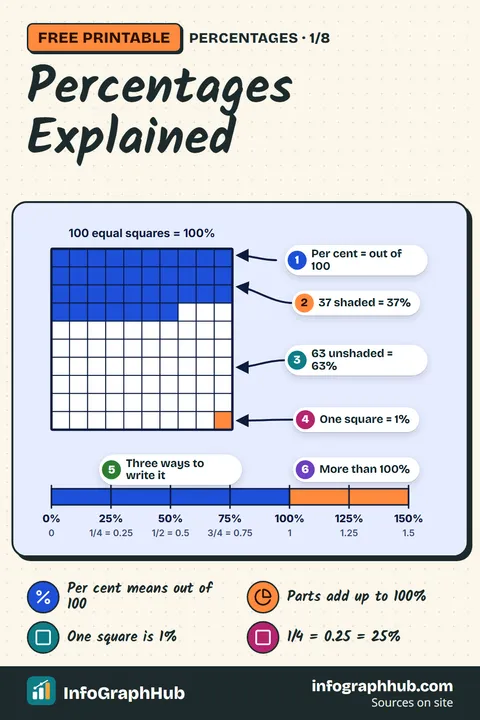
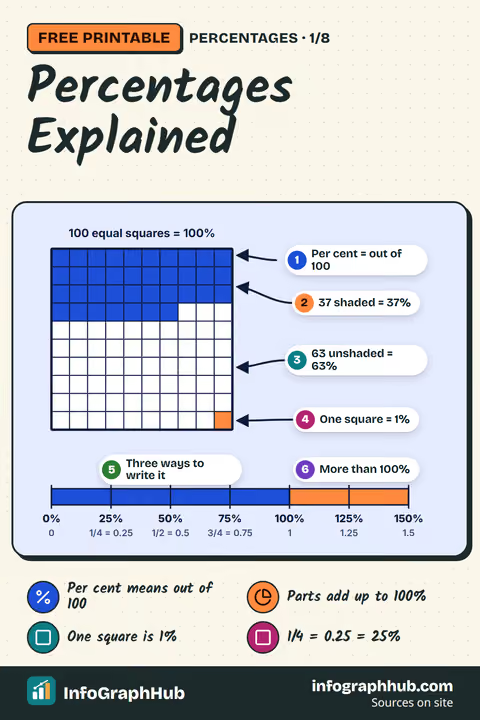
A percentage is a number of parts out of 100. The sign % is read as "per cent", from the Latin per centum, "by the hundred". So 37% means 37 parts in every 100: the fraction 37/100, or the decimal 0.37.
Picture a grid of 100 equal squares. Shade 37 of them and you have shaded 37% of the grid. The 63 squares left are 63%, and together the two parts make the whole: 37% + 63% = 100%. A single square is 1%, one hundredth of the whole, and a row of ten squares is 10%, one tenth.
Percentages are useful because they put different totals on the same scale. A score of 18 out of 24 and a score of 30 out of 40 do not look alike, but both are 75%, so they are equally good. That is why exam boards, shops, banks and newspapers all use them.
100% is the whole amount, but percentages are not stuck between 0 and 100. A plant that grows from 40 cm to 60 cm is now 150% of its old height, and 0.5% is half of one per cent.
See the infographic: Part 1, Percentages Explained: What a Percentage Means →
Fractions, decimals and percentages
The same amount can be written in three ways. Moving between them is the skill behind every other method in this series.
- Percentage to decimal: divide by 100. 45% = 0.45, 7% = 0.07 and 120% = 1.2.
- Decimal to percentage: multiply by 100. 0.375 = 37.5%.
- Fraction to percentage: divide the top by the bottom, then multiply by 100. 3/8 = 0.375 = 37.5%.
- Percentage to fraction: write it over 100 and simplify. 45% = 45/100 = 9/20.
| Fraction | Decimal | Percentage |
|---|---|---|
| 1/2 | 0.5 | 50% |
| 1/4 | 0.25 | 25% |
| 3/4 | 0.75 | 75% |
| 1/5 | 0.2 | 20% |
| 1/10 | 0.1 | 10% |
| 1/8 | 0.125 | 12.5% |
| 1/3 | 0.333… | about 33.3% |
Take care with place value for small percentages: 7% is 0.07, not 0.7, and 4% of 250 is 10, not 100.
See the infographic: Part 1, Percentages Explained: What a Percentage Means →
Finding a percentage of an amount
To find a percentage of an amount you either build it from easy pieces in your head or turn it into a decimal and multiply.
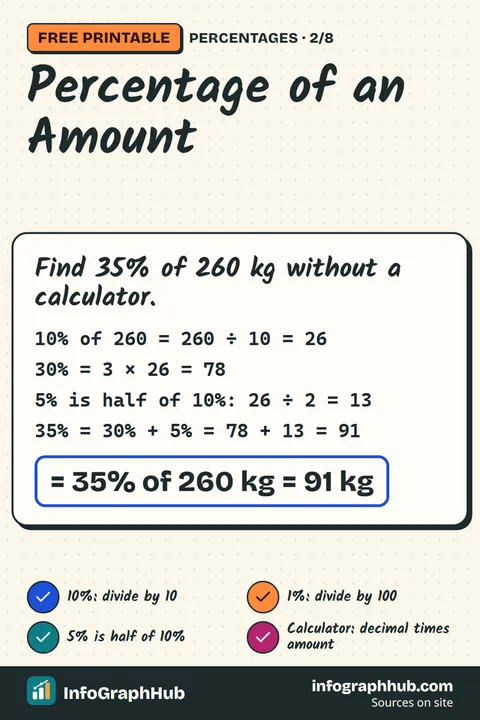
Mental methods. 10% is the amount divided by 10, 5% is half of 10%, and 1% is the amount divided by 100. Combine the pieces you need:
- 35% of 260: 10% is 26, so 30% is 78. 5% is 13. 35% = 78 + 13 = 91.
- 23% of 850: 10% is 85, so 20% is 170. 1% is 8.5, so 3% is 25.5. 23% = 170 + 25.5 = 195.5.
Calculator method. Divide the percentage by 100 to get a decimal multiplier, then multiply. If you have used 68% of a 12 GB data plan, you have used 0.68 × 12 = 8.16 GB.
One trick makes some questions easy: x% of y is always the same as y% of x. 8% of 50 looks awkward, but 50% of 8 is 4, so 8% of 50 is 4 too. Whatever method you use, estimate first: 23% is a bit less than a quarter, and a quarter of 850 is about 212, so 195.5 is sensible.
See the infographic: Part 2, Finding a Percentage of an Amount: Worked Examples →
Increasing and decreasing by a percentage
There are two ways to increase or decrease an amount by a percentage.
- Find the change, then add or subtract it. To increase 240 by 15%: 15% of 240 is 36, and 240 + 36 = 276. To decrease it by 15%: 240 − 36 = 204.
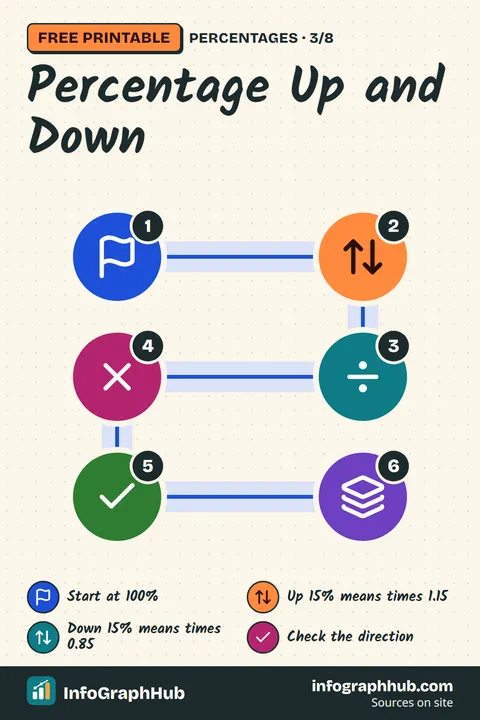
- Use a multiplier. The original amount is 100%. An increase of 15% leaves you with 115% of it, so the multiplier is 1.15. A decrease of 15% leaves 85%, so the multiplier is 0.85. Then 240 × 1.15 = 276 and 240 × 0.85 = 204, each in one step.
The multiplier method is quicker on a calculator and is the method you need for reverse percentages and repeated changes.
| Change | Percentage left | Multiplier |
|---|---|---|
| Increase by 5% | 105% | 1.05 |
| Increase by 50% | 150% | 1.5 |
| Increase by 100% | 200% | 2 |
| Decrease by 3% | 97% | 0.97 |
| Decrease by 40% | 60% | 0.6 |
A quick check: a multiplier bigger than 1 makes the amount grow, and a multiplier between 0 and 1 makes it shrink. For several changes in a row, multiply by each multiplier in turn. Two rises of 15% give 1.15 × 1.15 = 1.3225, a rise of 32.25%, not 30%.
See the infographic: Part 3, Percentage Increase and Decrease: Step by Step →
Percentage change and reverse percentages
A percentage change says how big a change is compared with where it started:
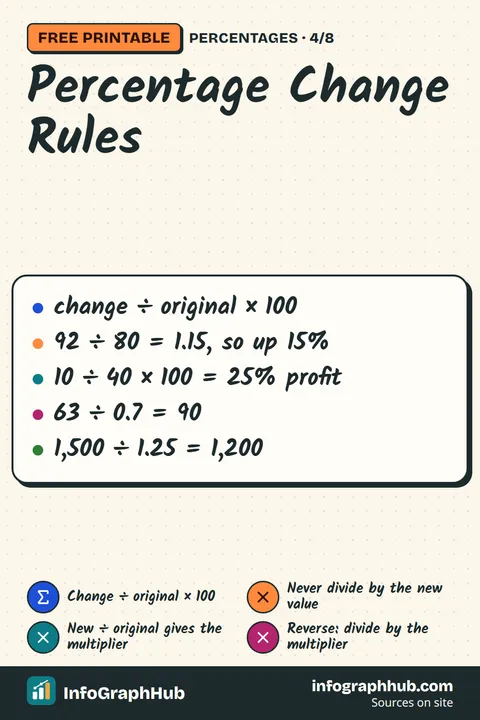
percentage change = change ÷ original value × 100
If a price goes from 80 to 92, the change is 12, and 12 ÷ 80 × 100 = a 15% increase. If a town's bus fleet falls from 250 to 190 buses, the change is 60, and 60 ÷ 250 × 100 = a 24% decrease. Another route is to divide the new value by the original: 92 ÷ 80 = 1.15, which is the multiplier for a 15% rise. In buying and selling the same rule gives percentage profit: buy for 40, sell for 50, and the profit is 10 ÷ 40 × 100 = 25%.
In a reverse percentage problem you know the value after the change and need the value before it. Write the new value as a percentage of the original, turn that into a multiplier and divide:
- After 30% off, a jacket costs 63. The sale price is 70% of the original, so the original was 63 ÷ 0.7 = 90.
- After a 25% pay rise, a wage is 1,500 a month. That is 125% of the old wage, so the old wage was 1,500 ÷ 1.25 = 1,200.
Always check by working forwards: 90 × 0.7 = 63 and 1,200 × 1.25 = 1,500.
See the infographic: Part 4, Percentage Change and Reverse Percentages: The Rules →
Percentages and percentage points
When the numbers being compared are themselves percentages, there are two different ways to describe the change, and both are correct.
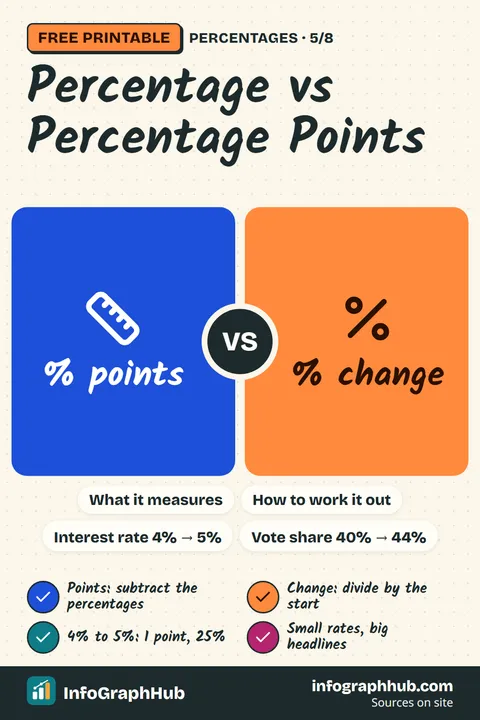
- Percentage points are the plain difference: subtract one percentage from the other.
- Percentage change compares the difference with the starting percentage.
If an interest rate rises from 4% to 5%, it has gone up by 1 percentage point, but that is a 25% increase in the rate, because 1 ÷ 4 × 100 = 25. If a party's share of the vote goes from 40% to 44%, it gained 4 percentage points, which is a 10% rise in its share.
The difference matters most when the starting percentage is small. A risk that goes from 0.1% to 0.2% has doubled, a 100% increase, yet it has only risen by 0.1 of a percentage point. Headlines often quote whichever sounds bigger. Statisticians use percentage points to compare two rates side by side too: if 85.9% of one group and 81.4% of another have a qualification, the gap is 4.5 percentage points. You will sometimes see percentage points shortened to pp.
See the infographic: Part 5, Percentage vs Percentage Points: What Is the Difference? →
Common mistakes and repeated changes
Most percentage errors come from losing track of what the percentage is of.
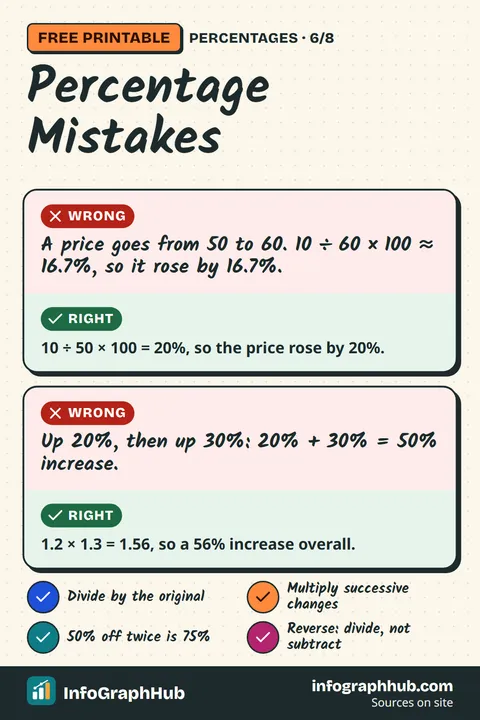
- Dividing by the new value. A price that rises from 50 to 60 has gone up by 10 ÷ 50 × 100 = 20%, not 10 ÷ 60 × 100 ≈ 16.7%.
- Adding successive percentages. A rise of 20% followed by a rise of 30% is × 1.2 × 1.3 = × 1.56, a 56% rise, because the second rise is taken of a bigger amount.
- Thinking 50% off, then 50% off, is free. You pay 0.5 × 0.5 = 0.25 of the price, so the total discount is 75%.
- Expecting a rise and fall to cancel. 200 up 10% is 220, and 220 down 10% is 198, not 200.
- Reversing with the wrong operation. If a price is 72 after a 20% rise, the original is 72 ÷ 1.2 = 60. Taking 20% off 72 gives 57.60, which is wrong.
- Comparing percentages of different totals. 60% of a class of 20 is 12 students; 50% of a class of 40 is 20 students. The bigger percentage is the smaller group.
NRICH's problem Percentage Unchanged shows the same idea in geometry: if a rectangle's base grows by 10% and its area stays the same, its width must fall by 1 − 1 ÷ 1.1 ≈ 9.09%, not 10%.
See the infographic: Part 6, Common Percentage Mistakes and How to Avoid Them →
Percentages in everyday life
Percentages turn up wherever amounts are compared or changed.
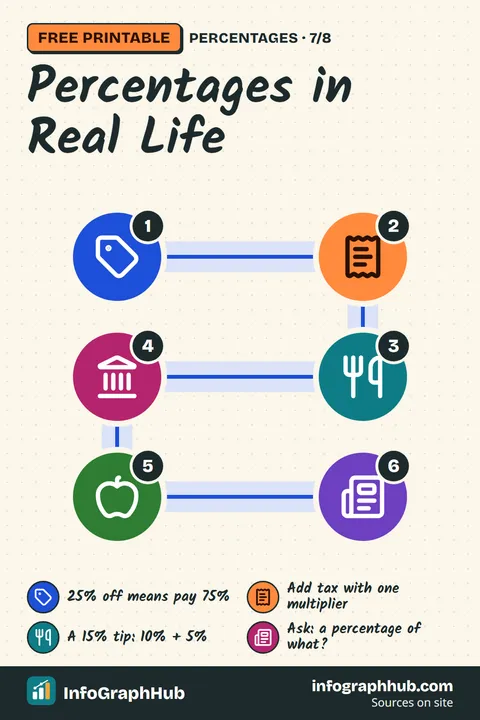
- Discounts. 25% off trainers priced 64 means paying 75%: 64 × 0.75 = 48.
- Taxes on spending. Depending on the country this is a value added tax (VAT), a goods and services tax (GST) or a sales tax. With an 8% sales tax, an item priced 35 costs 35 × 1.08 = 37.80.
- Tips. Where tipping is expected, 15% of a 42 bill is 10% (4.20) plus 5% (2.10), which makes 6.30.
- Interest. Savings paying 3% a year earn 15 on 500 in the first year. If the interest stays in the account, the second year pays 3% of 515, which is 15.45.
- Food labels. Labels compare a portion with a daily amount: US labels show a % Daily Value, where the FDA treats 5% or less as low and 20% or more as high, while UK and EU labels may show a percentage of the Reference Intake.
- The news. "Up 50%" sounds dramatic, but 2 cases rising to 3 is also a 50% rise. Always ask: a percentage of what, and how many is that?
See the infographic: Part 7, Percentages in Everyday Life: 8 Real Examples →
How to practise percentages
Percentages reward a short routine more than memorised tricks:
- Ask what the percentage is of: the original amount, the new amount or the whole.
- Estimate before you calculate, using 10%, 25% or 50%.
- For changes, write the multiplier first: 1.15 for up 15%, 0.85 for down 15%.
- Check by working forwards or backwards.
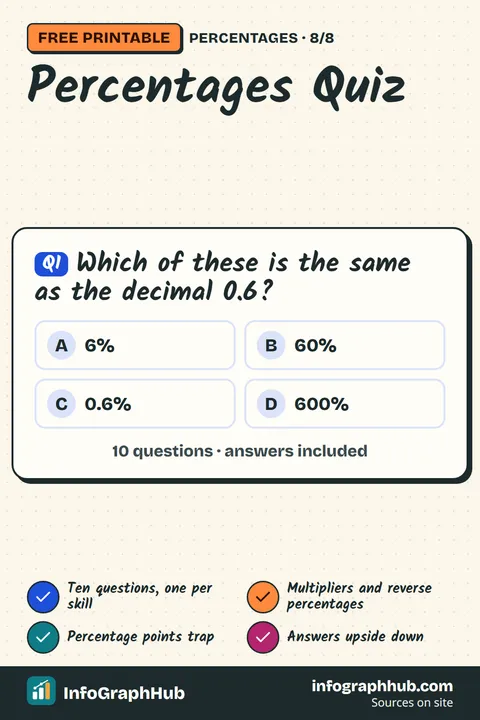
The quiz at the end of the series has ten questions, one or more on every part, with the answers printed upside down so you can try them first. NRICH's percentage problems and Khan Academy's practice sets on tax, tips and discounts are good next steps for extra practice.
See the infographic: Part 8, Percentages Quiz: Test Yourself →
Frequently asked questions
How do you work out a percentage of an amount?
Divide the percentage by 100 and multiply by the amount: 35% of 260 is 0.35 × 260 = 91. Without a calculator, build it from 10% (divide by 10), 5% (half of 10%) and 1% (divide by 100): 78 + 13 = 91.
How do you calculate a percentage increase?
Use a multiplier: add the increase to 100% and divide by 100. To increase 240 by 15%, multiply by 1.15 to get 276. Or find 15% of 240 (36) and add it on.
What is the formula for percentage change?
Percentage change = change ÷ original value × 100. A price that goes from 80 to 92 changes by 12, and 12 ÷ 80 × 100 = 15%. Always divide by the value before the change.
How do you find the original price before a discount?
Work out what percentage of the original is left, turn it into a multiplier and divide. After 30% off, a jacket costs 63, which is 70% of the original, so the original was 63 ÷ 0.7 = 90.
What is the difference between a percentage and a percentage point?
A percentage point is the plain difference between two percentages. A rate rising from 4% to 5% is up 1 percentage point, but that is a 25% increase in the rate, because 1 ÷ 4 × 100 = 25.
Why does a 10% rise followed by a 10% fall not get you back to the start?
Because the fall is 10% of a bigger number. 200 rises by 10% to 220, then falls by 10% of 220, which is 22, to 198. In multipliers, 1.1 × 0.9 = 0.99, a 1% fall overall.
Sources & methodology
Every fact is checked against the sources below. We write original explanations and draw original graphics; no figures are copied from textbooks. Spotted an error? See our corrections policy.
- Percentage change (BBC Bitesize, accessed 1 Oct 2026)
- Repeated percentage change, interest and exponential change (BBC Bitesize, accessed 1 Oct 2026)
- 7th grade math, Unit 2: Rates and percentages (Khan Academy, accessed 1 Oct 2026)
- Percentages (problem collection) (NRICH, University of Cambridge, accessed 1 Oct 2026)
- Percentage Unchanged (NRICH, University of Cambridge, accessed 1 Oct 2026)
- Percentage Change (Maths is Fun, accessed 1 Oct 2026)
- Percentage Points (Maths is Fun, accessed 1 Oct 2026)
- Beginners: Statistical concept – Percentage change and percentage points (Eurostat (European Commission), accessed 1 Oct 2026)
- National curriculum in England: mathematics programmes of study (Department for Education (GOV.UK), accessed 1 Oct 2026)
- How to Understand and Use the Nutrition Facts Label (U.S. Food and Drug Administration (FDA), accessed 1 Oct 2026)
Editorial review pending · Updated
For teachers and parents: new InfoGraphHub resources by email
One short email when new free resources go live. For adults (18+) only. No spam, no tracking in emails, unsubscribe anytime.