Percentages Explained: What a Percentage Means
What a percentage is, shown on a hundred square: per cent means out of 100, the parts of a whole add up to 100%, 1% is one hundredth, and the same amount can be written as a fraction, a decimal or a percentage, including values above 100%.
Ages 11–16 · Grades 6–10 (US) · Years 7–11 (UK) · Classes 6–10 (India)
- Common Core Math 6.RP.A.3c
- Common Core Math 7.RP.A.3
- England KS3 Years 7–9
- AQA GCSE R9
- Cambridge IGCSE 0580 C1.13 / E1.13
- Australian Curriculum v9 AC9M7N06
- Australian Curriculum v9 AC9M8N05
- CBSE Class 8
Cambridge and IGCSE are trademarks of Cambridge University Press & Assessment. Common Core State Standards © Copyright 2010 National Governors Association Center for Best Practices and Council of Chief State School Officers. All rights reserved. Names and codes are used only to describe curriculum fit; InfoGraphHub is not endorsed by these organisations.
What a percentage means
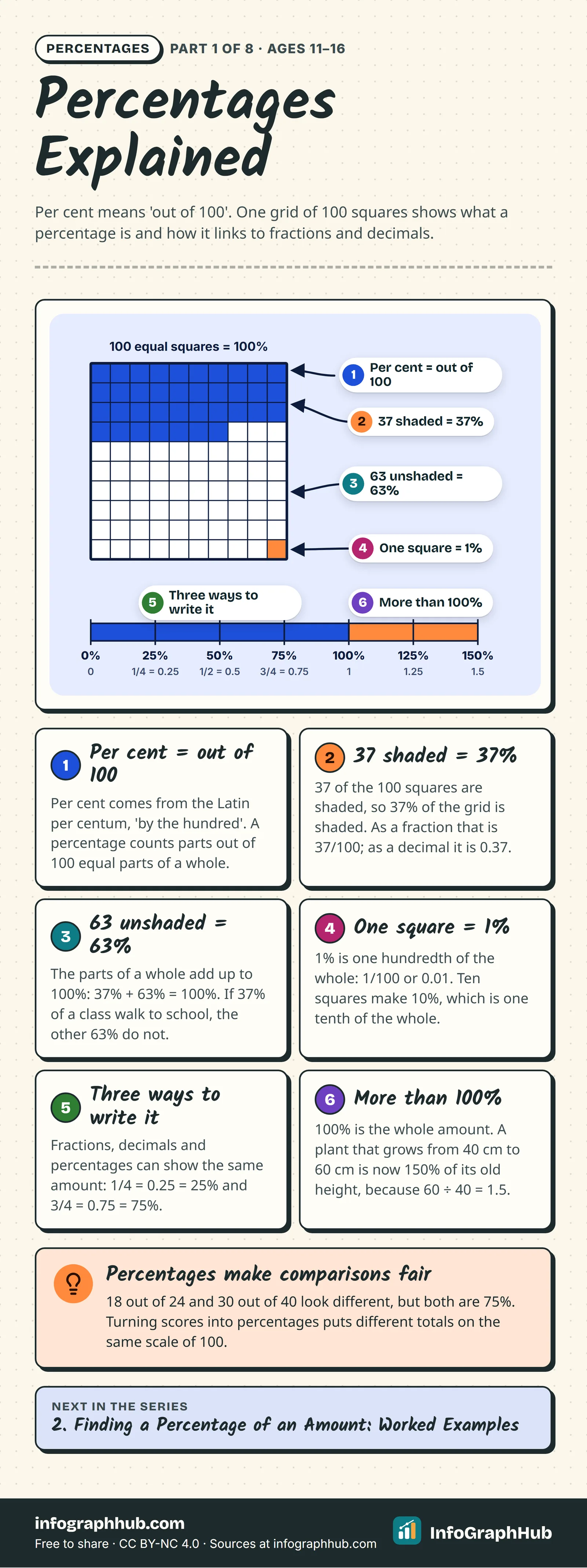
A percentage is a number of parts out of 100. The word comes from the Latin per centum, "by the hundred", and the sign % is read as "per cent". So 37% means 37 out of every 100: the fraction 37/100 or the decimal 0.37.
A hundred square makes this easy to see. It is a 10 × 10 grid of 100 equal squares, so every square is 1% of the whole. Shade 37 squares and 37% of the grid is shaded. The 63 squares left are 63%, and together the two parts make the whole grid: 37% + 63% = 100%. That is a useful check whenever a whole is split into parts: the percentages should add up to 100%.
Fractions, decimals and percentages
A percentage is another way of writing a fraction or a decimal, so you can move between all three:
- Percentage to decimal: divide by 100. 45% = 0.45 and 7% = 0.07.
- Decimal to percentage: multiply by 100. 0.375 = 37.5%.
- Fraction to percentage: divide the top by the bottom, then multiply by 100. 3/8 = 0.375 = 37.5%.
- Percentage to fraction: write it over 100 and simplify. 45% = 45/100 = 9/20.
Small percentages need care with place value. 7% is seven hundredths, 0.07, not seven tenths.
Equivalents worth knowing
A few equivalents come up so often that they are worth knowing by heart: 1/2 = 0.5 = 50%, 1/4 = 0.25 = 25%, 3/4 = 0.75 = 75%, 1/5 = 0.2 = 20% and 1/10 = 0.1 = 10%. With these, many questions can be done in your head: 25% of something is a quarter of it and 20% is a fifth. On the number line in the infographic, each percentage sits directly above its matching fraction and decimal.
One amount as a percentage of another
To write one amount as a percentage of another, make a fraction and multiply by 100. A test score of 18 out of 24 is 18 ÷ 24 × 100 = 75%. A score of 30 out of 40 is also 75%, so the two results are equally good even though the totals are different. That is the main reason percentages are used: they put different totals on the same scale.
Both amounts must be in the same unit first. 45 cm out of 2 m is 45 cm out of 200 cm, which is 45 ÷ 200 × 100 = 22.5%.
Above 100% and below 1%
100% is the whole amount, but percentages do not have to stop there. If a plant grows from 40 cm to 60 cm, its new height is 60 ÷ 40 = 1.5 times the old one, or 150% of it. Percentages smaller than 1% are possible too: 0.5% is half of one per cent, or 5 parts in every 1,000.
Where the series goes next
This part is about what a percentage is. The rest of the series puts the idea to work: finding a percentage of an amount, increasing and decreasing with multipliers, measuring a percentage change, telling percentages from percentage points, avoiding the most common mistakes, spotting percentages in everyday life and, finally, a quiz on all of it.
Frequently asked questions
What does per cent mean?
Per cent means "out of 100". It comes from the Latin per centum, "by the hundred". So 37% is 37 out of every 100, which is the fraction 37/100 or the decimal 0.37.
How do you change a fraction into a percentage?
Divide the top number by the bottom number, then multiply by 100. For example, 3/8 = 3 ÷ 8 = 0.375, and 0.375 × 100 = 37.5%.
How do you write one number as a percentage of another?
Make a fraction with the total on the bottom, then multiply by 100. 18 out of 24 is 18 ÷ 24 × 100 = 75%. Put both amounts in the same unit first.
Can a percentage be more than 100%?
Yes. 100% is the whole of the starting amount, so anything bigger is more than 100%. A plant that grows from 40 cm to 60 cm is now 150% of its old height.
Sources & methodology
Every fact is checked against the sources below. We write original explanations and draw original graphics; no figures are copied from textbooks. Spotted an error? See our corrections policy.
- Introduction to Percents (Maths is Fun, accessed 1 Oct 2026)
- How to change a fraction into a percentage (BBC Bitesize, accessed 1 Oct 2026)
- Prealgebra 2e, 6.1 Understand Percent (OpenStax (Rice University), accessed 1 Oct 2026)
- National curriculum in England: mathematics programmes of study (Department for Education (GOV.UK), accessed 1 Oct 2026)
Editorial review pending · Updated
Embed this on your site
Paste this HTML into your page. Keep the credit line: it is required by the CC BY-NC 4.0 license.
Related infographics
 Maths
MathsRatio and Proportion: Cheat Sheet with Worked Examples
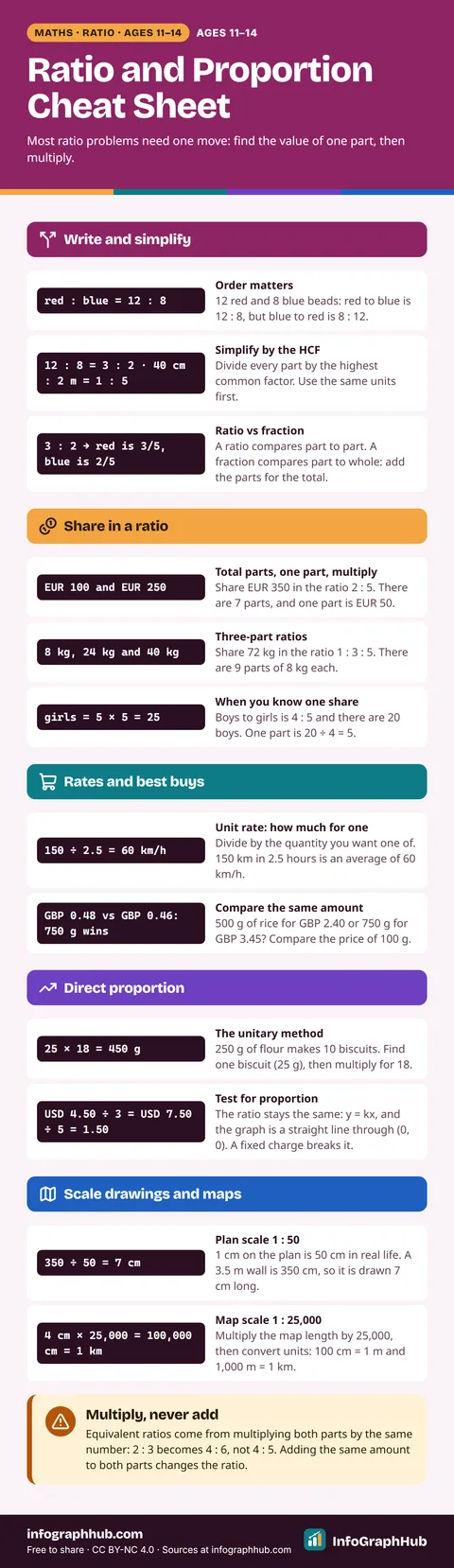
A one-page ratio and proportion cheat sheet: write and simplify ratios, tell a ratio from a fraction, share an amount in a ratio, use unit rates to find the best buy, solve direct proportion problems and read scales on drawings and maps.
 Finance
Compound Interest Explained: How Money Grows Over Time
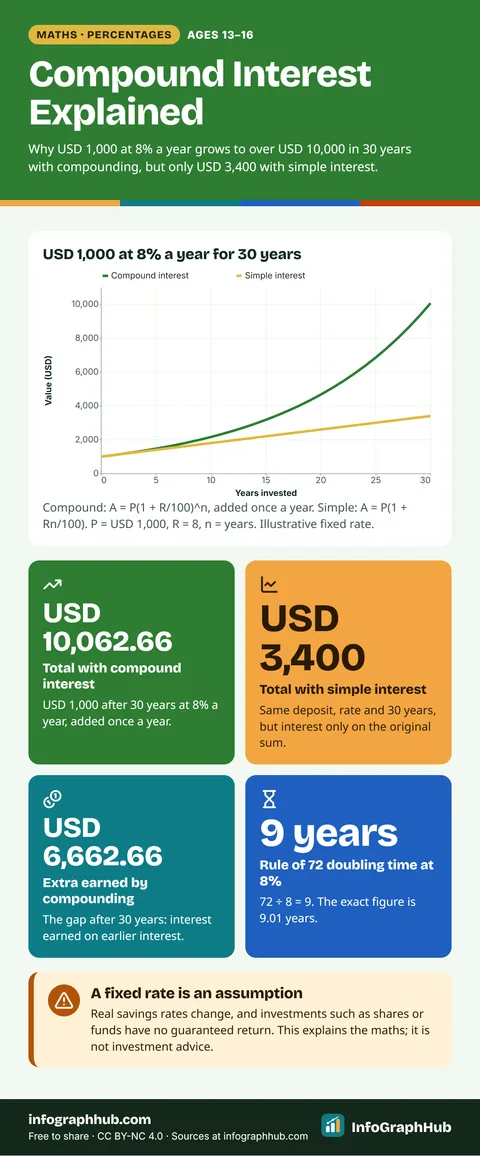
Compound interest is interest earned on interest. Each year's interest joins the balance, so the next year's interest is worked out on a bigger sum. Over 30 years at an example 8% rate, 1,000 grows to 10,062.66, against 3,400 with simple interest.
 Finance
Credit Scores in India: How They Work and Your RBI Rights
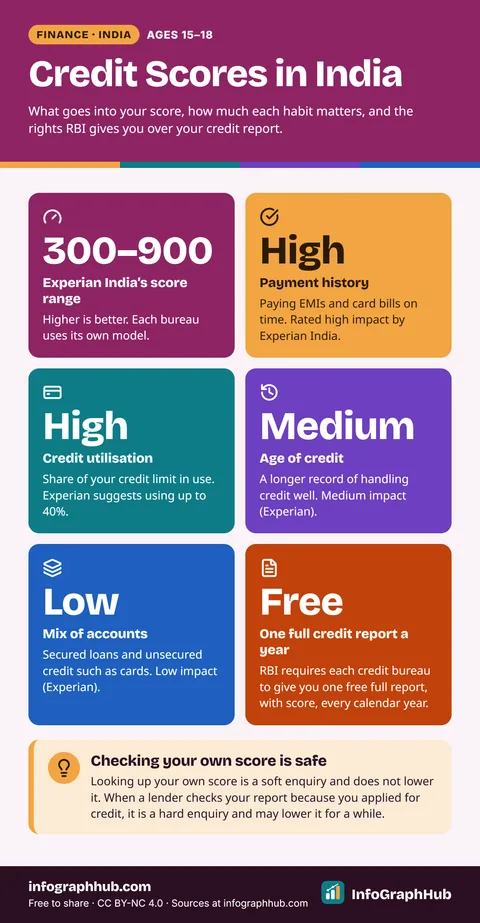
A credit score is a three-digit number, such as Experian India’s 300–900 score, built from your borrowing record. Paying on time and using little of your credit limit matter most; the age and mix of your accounts matter less.
 Science
Earth's Water by the Numbers
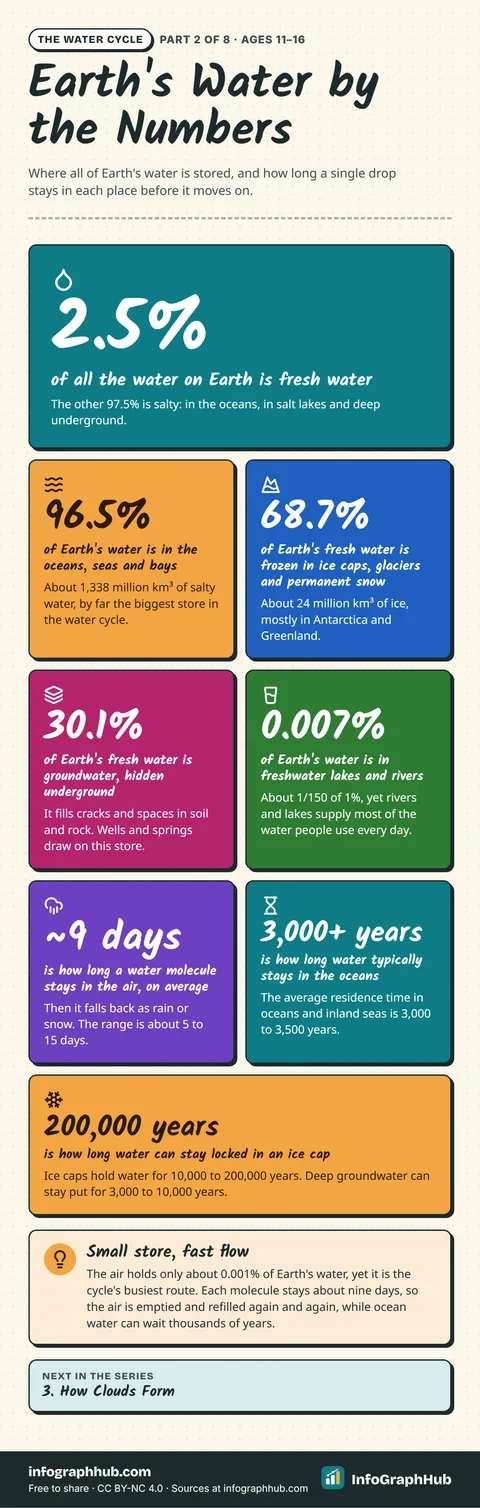
Where is all of Earth's water, and how long does it stay there? Only 2.5% is fresh, most of that is frozen or underground, and a drop can spend nine days in the air or thousands of years in the ocean or an ice cap.
 Tech
TechGit Commands Cheat Sheet: The Essentials for Beginners
The Git commands beginners use most: set up a repository with init or clone, save work with add and commit, build features on branches with switch and merge, share work with fetch, pull and push, and undo safely with restore.
 Science
How Clouds Form
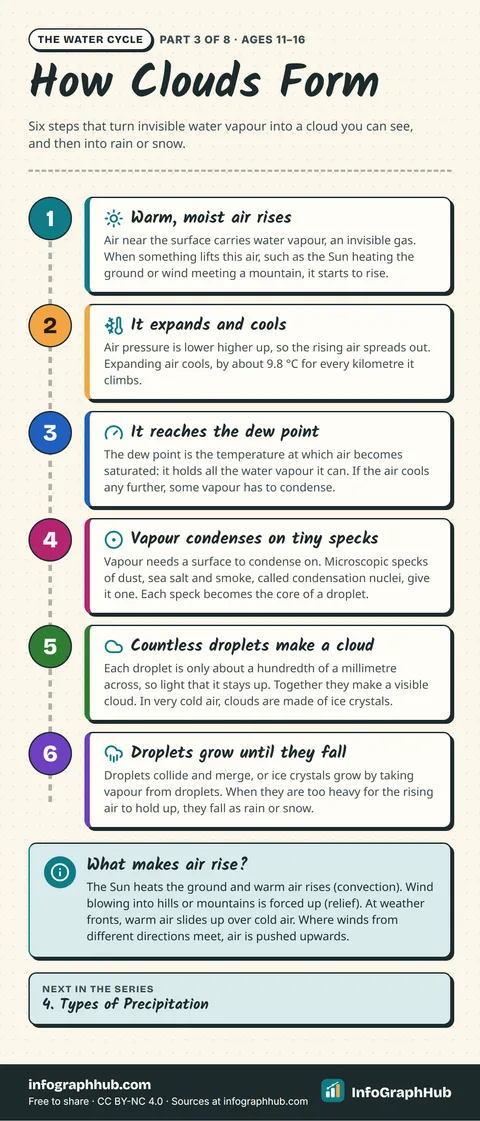
How does invisible water vapour become a cloud? Moist air rises, expands and cools to its dew point, then vapour condenses on specks of dust, salt and smoke into tiny droplets or ice crystals that grow until they fall as rain or snow.
For teachers and parents: new InfoGraphHub resources by email
One short email when new free resources go live. For adults (18+) only. No spam, no tracking in emails, unsubscribe anytime.