History & GeographyQuizPart 9 of 9, World War IUpdated 1 October 2026
World War I Quiz: Test Yourself
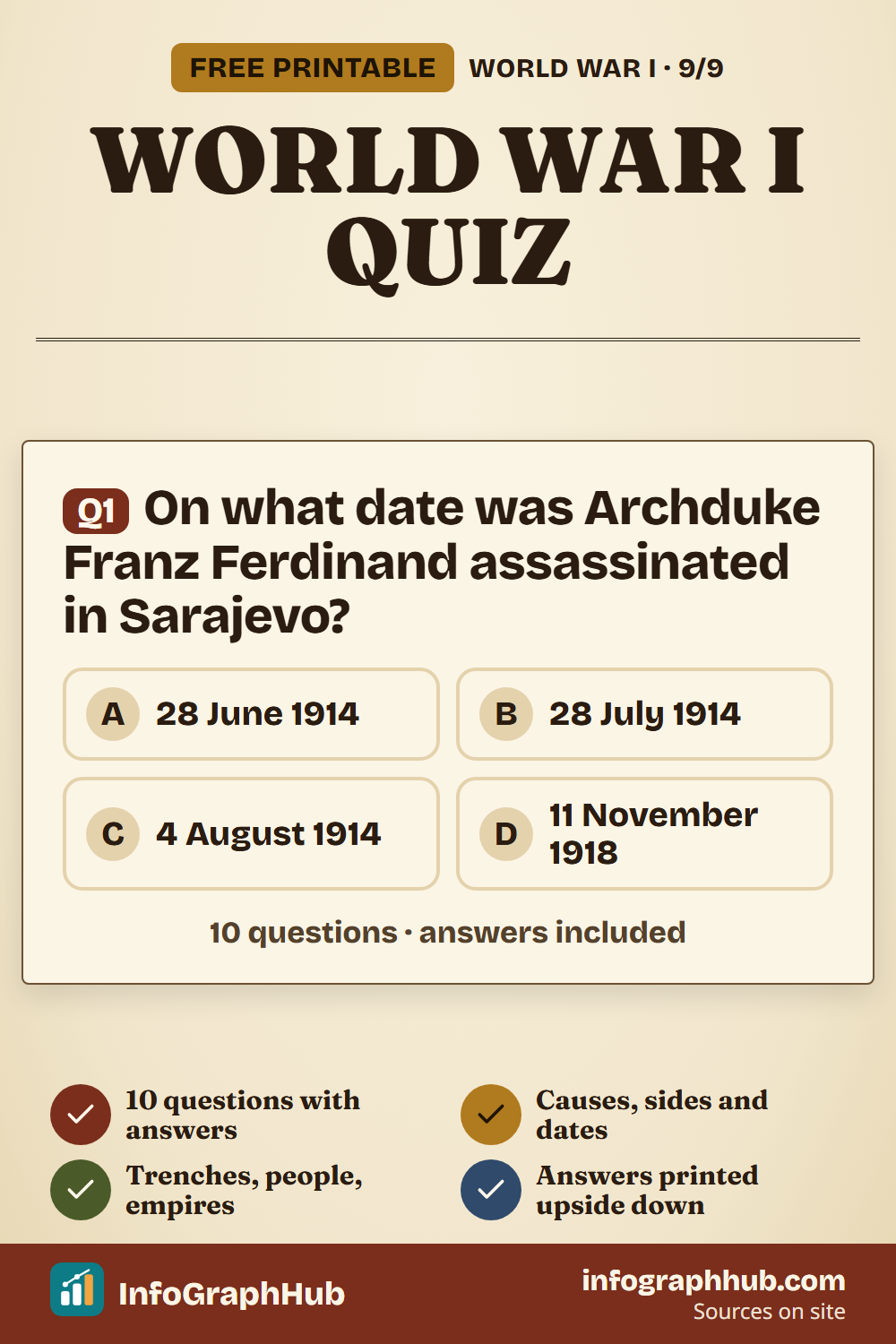
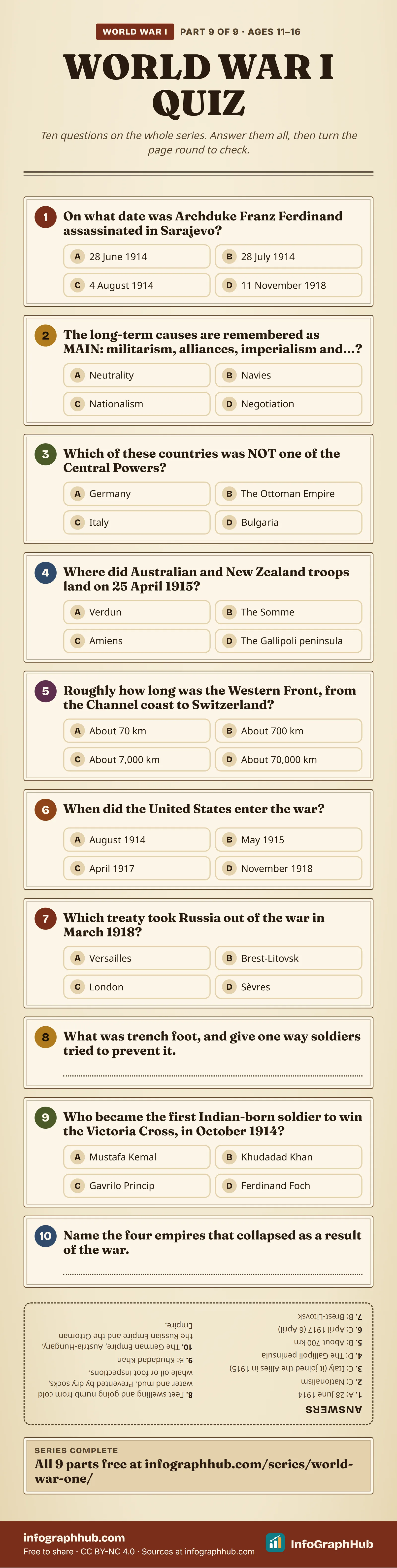
Ten questions covering the whole World War I series: the trigger and causes, the two sides, Gallipoli, the Western Front, the USA's entry, Russia's exit, trench life, a key soldier and the empires that fell. Eight are multiple choice and two need a short written answer, with a worked answer key.
Use this infographic
Free under CC BY-NC 4.0, with credit to InfoGraphHub.
How to use this quiz
Try all ten questions before you look at the answers. Questions 1 to 7 and 9 are multiple choice; questions 8 and 10 need a short written answer, so write a sentence or two. The answers are printed upside down at the foot of the infographic. The worked answers below explain why each answer is right, and which part of the series to revisit if you got it wrong.
1. The trigger
Answer: A, 28 June 1914. Archduke Franz Ferdinand, heir to the throne of Austria-Hungary, and his wife Sophie were shot in Sarajevo on 28 June 1914 by Gavrilo Princip, a 19-year-old Bosnian Serb nationalist. The other dates are traps: 28 July is when Austria-Hungary declared war on Serbia, 4 August is when Britain entered the war, and 11 November 1918 is the Armistice.
2. MAIN
Answer: C, nationalism. MAIN stands for militarism, alliances, imperialism and nationalism, the four long-term causes most often used to explain the war. Nationalism, a strong loyalty to one's own nation, was especially dangerous in the Balkans, where Serbia's hopes of uniting the South Slavs threatened Austria-Hungary.
3. The Central Powers
Answer: C, Italy. The Central Powers were Germany, Austria-Hungary, the Ottoman Empire and Bulgaria. Italy had been in the Triple Alliance with Germany and Austria-Hungary, but that alliance was defensive, so Italy stayed out in 1914 and joined the Allies in May 1915.
4. Gallipoli
Answer: D, the Gallipoli peninsula. On 25 April 1915 Australian and New Zealand troops, with British and French forces, landed on the Gallipoli peninsula in Ottoman Turkey. Ottoman forces, with Mustafa Kemal among their leading commanders, held them back, and the last Allied troops left in January 1916.
5. The Western Front
Answer: B, about 700 km. The Western Front ran from the Channel coast through Belgium and France to Switzerland. Sources give between 400 and 475 miles, about 640 to 765 km, so 'about 700 km' is a fair round figure. Seventy kilometres is far too short, and the two larger options would stretch far beyond France and Belgium.
6. The USA
Answer: C, April 1917. The United States declared war on Germany on 6 April 1917, after Germany resumed unrestricted submarine warfare and the Zimmermann Telegram, in which Germany proposed an alliance with Mexico, was made public.
7. Russia leaves the war
Answer: B, the Treaty of Brest-Litovsk. After the Bolsheviks took power in November 1917, they made peace with Germany at Brest-Litovsk on 3 March 1918, giving up large areas of the old Russian Empire. Versailles (1919) was the peace treaty with Germany, and Sèvres (1920) was with the Ottoman Empire.
8. Trench foot
Model answer: Trench foot was a painful condition caused by standing for long periods in cold water and mud. Feet swelled, went numb and could become infected, sometimes so badly that they had to be amputated. Soldiers tried to prevent it by drying their feet, changing into dry socks, rubbing whale oil on their feet and having their feet inspected. A full answer gives the cause and at least one method of prevention.
9. Khudadad Khan
Answer: B, Khudadad Khan. A machine gunner in the 129th Baluchis of the Indian Army, he kept his gun firing at Hollebeke in Belgium on 31 October 1914 after the rest of his team had been killed, and became the first Indian-born soldier to receive the Victoria Cross. Mustafa Kemal was an Ottoman commander, Gavrilo Princip was the assassin in Sarajevo, and Ferdinand Foch was the French general who led the Allied armies in 1918.
10. Four empires
Model answer: The German Empire, Austria-Hungary, the Russian Empire and the Ottoman Empire. Germany became a republic when the Kaiser abdicated, Austria-Hungary split apart, Russia's revolution led to the Soviet Union, and the Ottoman lands were divided, with the Republic of Turkey emerging from its heartland.
Frequently asked questions
How can teachers use this World War I quiz?
As a starter or plenary, as a check at the end of the topic, or as homework. Students can mark each other's work with the upside-down answer strip, then use the worked answers to discuss the questions they got wrong.
Which parts of the series does the quiz cover?
All of them: the overview, the causes, the timeline, the Allies and the Central Powers, the numbers, life in the trenches, the key people and the consequences of the war.
Why are the answers printed upside down?
So you can answer every question without seeing the answers by accident. When you have finished, turn the page round to check.
What should I do if I get a question wrong?
Read the worked answer, then go back to the matching part of the series. For example, a wrong answer on Brest-Litovsk points to the timeline, and a wrong answer on trench foot points to Life in the Trenches.
Sources & methodology
Every fact is checked against the sources below. We write original explanations and draw original graphics; no figures are copied from textbooks. Spotted an error? See our corrections policy.
- Outbreak of the First World War (Imperial War Museums (IWM), accessed 1 Oct 2026)
- Causes of World War One (BBC Bitesize (KS3 History), accessed 1 Oct 2026)
- 5 Facts You Need To Know About The First World War (Imperial War Museums (IWM), accessed 1 Oct 2026)
- First World War key battles (Imperial War Museums (IWM), accessed 1 Oct 2026)
- Key Dates (National WWI Museum and Memorial, accessed 1 Oct 2026)
- Keeping Clean And Healthy In Trenches During World War 1 (Imperial War Museums (IWM), accessed 1 Oct 2026)
- Life story: Khudadad Khan (Imperial War Museums, Lives of the First World War, accessed 1 Oct 2026)
- Paris Peace Conference (National WWI Museum and Memorial, accessed 1 Oct 2026)
Editorial review pending · Updated
Made by the InfoGraphHub editorial team (how we research and check: editorial and AI policy). First published 2 October 2026, last reviewed 1 October 2026. Found a mistake? Tell the editors.
For teachers: ages and curriculum fit
Ages 11–16 · Grades 6–10 (US) · Years 7–11 (UK) · Classes 6–10 (India)
Embed this on your site
Paste this HTML into your page. Keep the credit line: it is required by the CC BY-NC 4.0 license.
Related infographics


For teachers and parents: new InfoGraphHub resources by email
One short email when new free resources go live. For adults (18+) only. No spam, no tracking in emails, unsubscribe anytime.