History & GeographyNumbersPart 5 of 9, World War IUpdated 1 October 2026
World War I by the Numbers
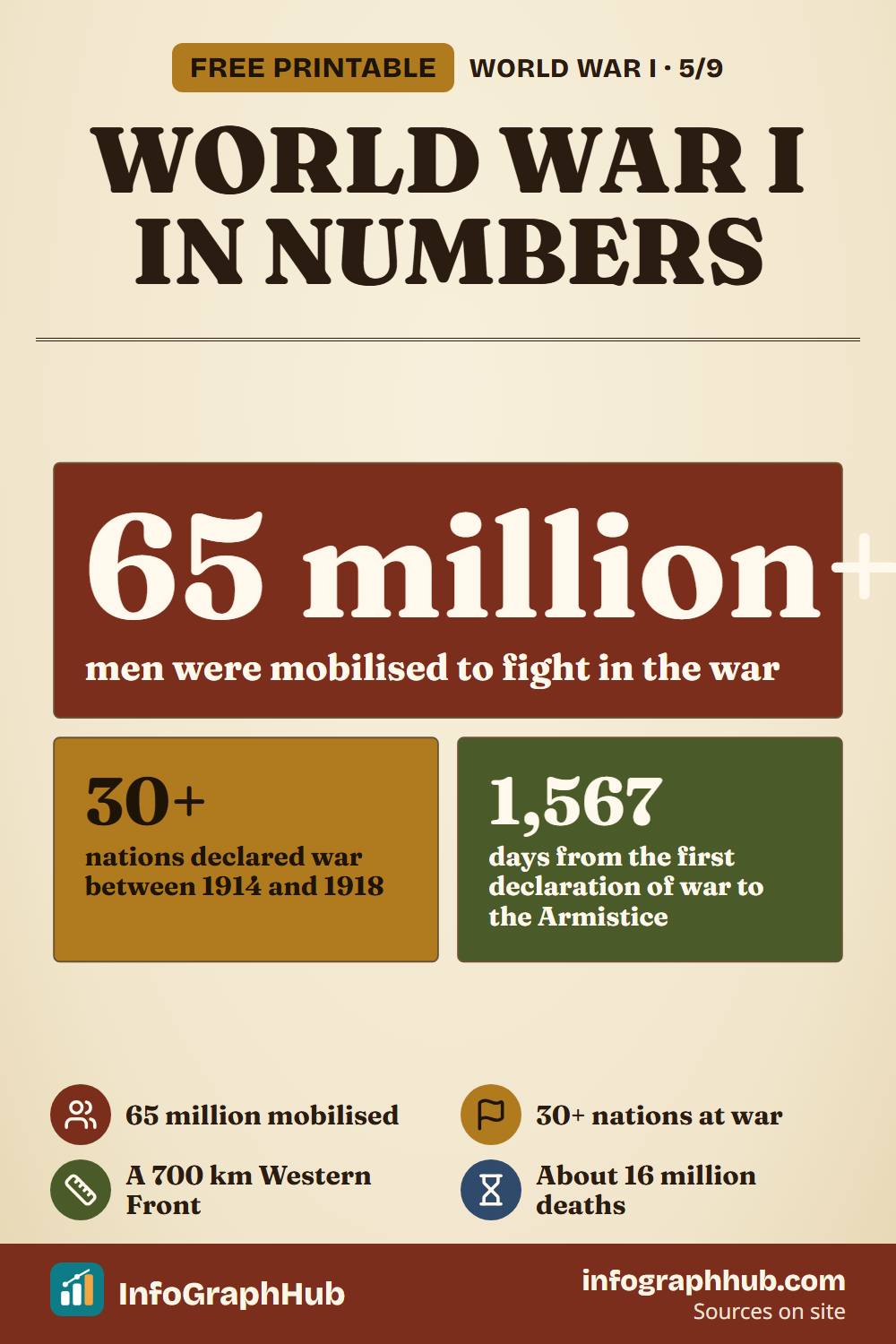
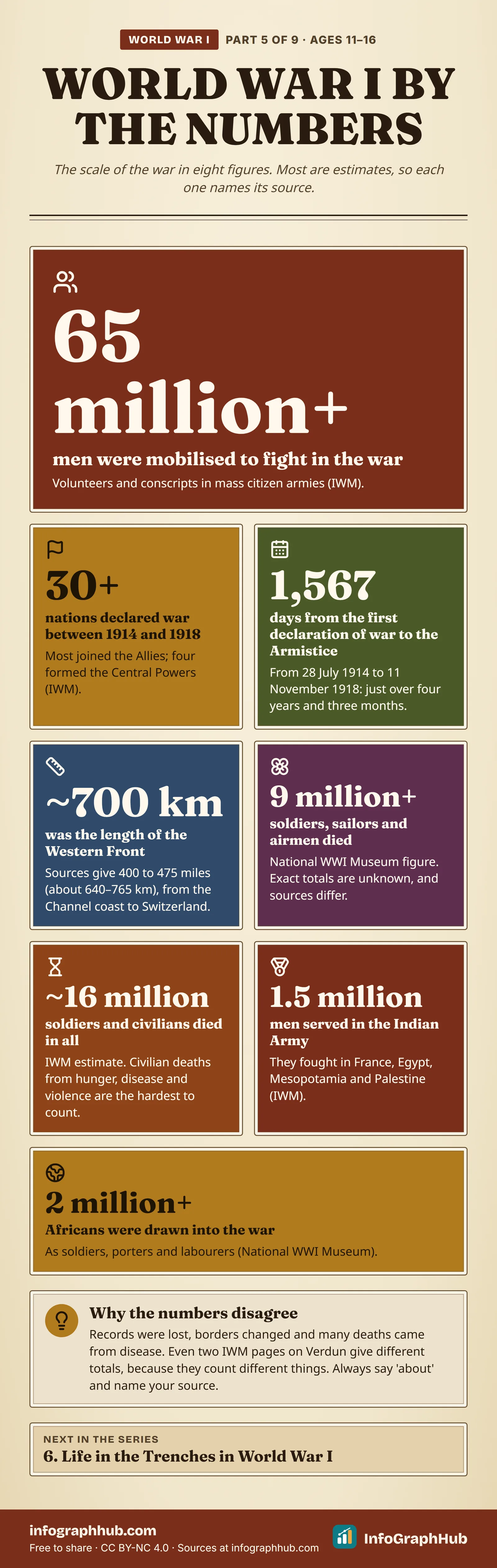
The scale of World War I in eight numbers: over 65 million men mobilised, more than 30 nations at war, 1,567 days of fighting, a Western Front of about 700 km, more than 9 million military deaths and about 16 million deaths in all, with sources named and their differences explained.
Use this infographic
Free under CC BY-NC 4.0, with credit to InfoGraphHub.
Why the numbers are hard to pin down
Almost every number about World War I is an estimate. Many records were lost or never kept, especially in Russia, the Ottoman Empire and the colonies. Borders changed after the war, so it is not always clear which country a soldier belonged to. Many soldiers died of disease rather than in battle, and many civilians died of hunger, illness or violence far from any front, which makes them very hard to count.
That is why reputable sources give different figures. This page names the source of each number. When you quote a figure in your own work, do the same, and use words such as 'about' or 'more than'.
Armies of millions
According to the Imperial War Museums (IWM), more than 65 million men volunteered or were conscripted to fight, and over 30 nations declared war between 1914 and 1918. Armies grew enormously: the National WWI Museum notes that Italy's army had fewer than 300,000 soldiers when the war began but more than 5 million had been mobilised by November 1918.
The war was fought by people from every inhabited continent. IWM gives 1.5 million as the number of men in the Indian Army, which fought in France, Egypt, Mesopotamia and Palestine. The National WWI Museum says that more than two million Africans were drawn into the war as soldiers, porters and labourers, and that at least four million non-white troops served on the two sides. From a population of fewer than five million, 416,809 Australian men enlisted, according to the Australian War Memorial.
The cost in lives
The National WWI Museum states that more than 9 million combatants died, more than in any earlier war. IWM estimates that about 16 million soldiers and civilians died altogether. The gap between the two figures, roughly 7 million, gives a rough idea of the civilian toll, but civilian deaths are the least certain numbers of all.
Even single battles have different totals in different places. One IWM page says the French lost 377,000 men and the Germans 330,000 at Verdun in 1916; another gives about 550,000 French and over 430,000 German killed or wounded. Neither is careless: they count different things over different periods.
Some numbers are known precisely. On 1 July 1916, the first day of the Battle of the Somme, the British army had 57,470 casualties, of whom 19,240 were killed: the deadliest day in its history.
Working with the numbers
Percentages help to compare. The Australian War Memorial records that more than 60,000 of the 416,809 Australians who enlisted were killed:
60,000 ÷ 416,809 ≈ 0.144, or about 14 per cent, roughly 1 in 7.
The war's length can be worked out from its dates. From Austria-Hungary's declaration of war on 28 July 1914 to the Armistice on 11 November 1918 is 1,567 days, a little over four years and three months.
A front 700 km long
The Western Front ran from the Channel coast through Belgium and France to the Swiss border. Its length is usually given as about 700 km, but sources differ: BBC Bitesize gives 400 miles (about 640 km) and the National WWI Museum about 475 miles (about 765 km). The line was not a single trench but a network of front, support and reserve trenches, and it moved very little between late 1914 and spring 1918.
Frequently asked questions
How many people died in World War I?
Estimates differ. The Imperial War Museums estimate about 16 million soldiers and civilians in total, and the National WWI Museum and Memorial says more than 9 million combatants died. Civilian deaths are the hardest to count, so all totals are approximate.
How many soldiers fought in World War I?
More than 65 million men volunteered or were conscripted, according to the Imperial War Museums. They came from over 30 nations and from colonies and dominions around the world, including about 1.5 million men in the Indian Army.
How long was the Western Front?
About 700 km, from the Channel coast to the Swiss border. Sources vary between about 400 miles (640 km) and 475 miles (765 km), partly because the line bent and changed over the war.
Why do sources give different numbers for World War I?
Records were lost or never kept, borders changed after the war, and historians count different things: some include deaths from disease or among prisoners, some include the missing, and civilian deaths from hunger and illness are especially hard to measure.
Sources & methodology
Every fact is checked against the sources below. We write original explanations and draw original graphics; no figures are copied from textbooks. Spotted an error? See our corrections policy.
- 5 Facts You Need To Know About The First World War (Imperial War Museums (IWM), accessed 1 Oct 2026)
- The World Remembers (National WWI Museum and Memorial, accessed 1 Oct 2026)
- Trench Warfare (National WWI Museum and Memorial, accessed 1 Oct 2026)
- Causes of World War One (BBC Bitesize (KS3 History), accessed 1 Oct 2026)
- India and the First World War (Imperial War Museums (IWM), accessed 1 Oct 2026)
- Forgotten Fronts: Africa and the Global Impact of World War I (National WWI Museum and Memorial, accessed 1 Oct 2026)
- First World War 1914–18 (Australian War Memorial, accessed 1 Oct 2026)
- First World War key battles (Imperial War Museums (IWM), accessed 1 Oct 2026)
- Battle of Verdun (Imperial War Museums (IWM), accessed 1 Oct 2026)
- Italy Enters World War I (National WWI Museum and Memorial, accessed 1 Oct 2026)
Editorial review pending · Updated
Made by the InfoGraphHub editorial team (how we research and check: editorial and AI policy). First published 2 October 2026, last reviewed 1 October 2026. Found a mistake? Tell the editors.
For teachers: ages and curriculum fit
Ages 11–16 · Grades 6–10 (US) · Years 7–11 (UK) · Classes 6–10 (India)
Embed this on your site
Paste this HTML into your page. Keep the credit line: it is required by the CC BY-NC 4.0 license.
Related infographics


For teachers and parents: new InfoGraphHub resources by email
One short email when new free resources go live. For adults (18+) only. No spam, no tracking in emails, unsubscribe anytime.