History & GeographyVisual listPart 7 of 9, World War IUpdated 1 October 2026
Key People of World War I
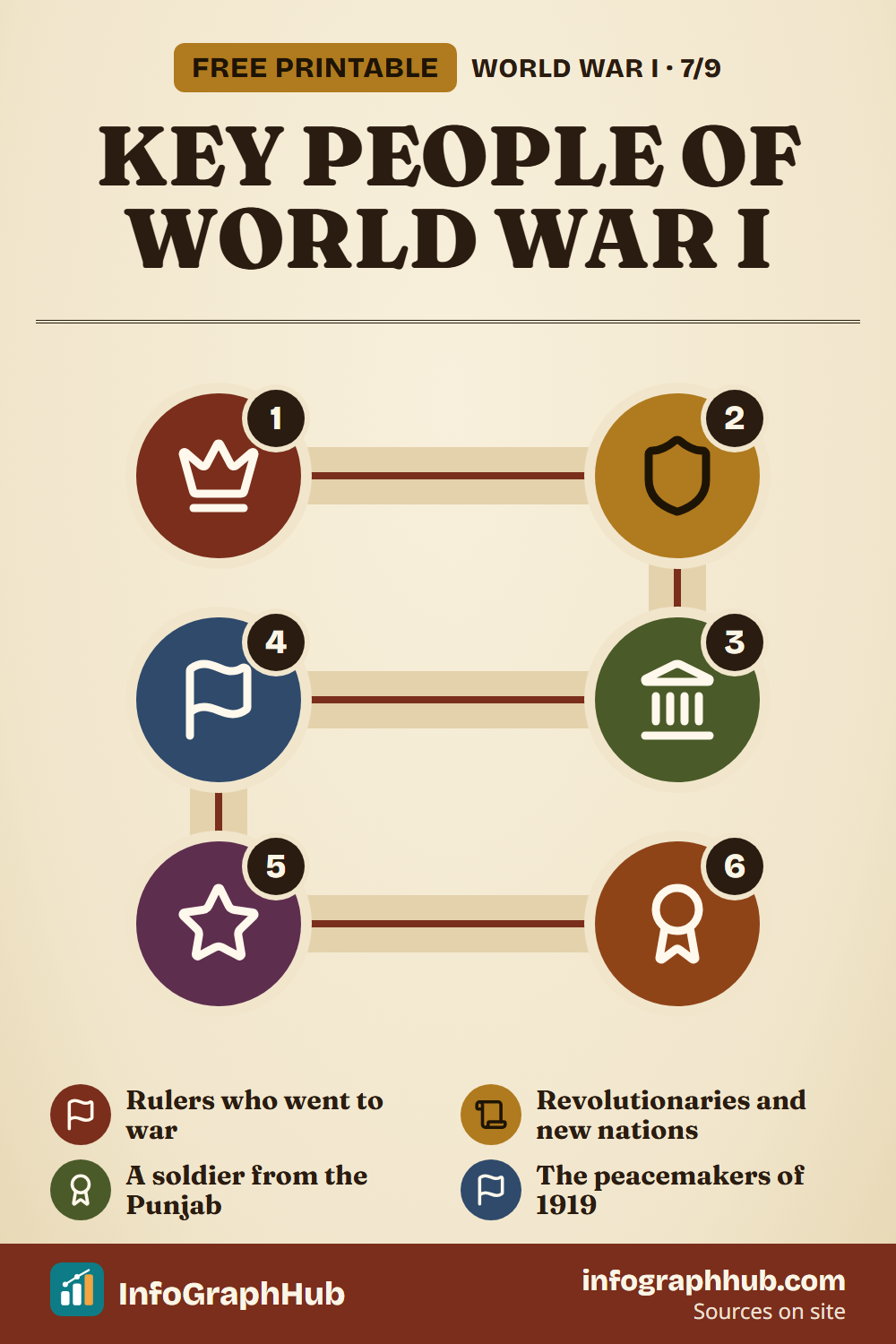
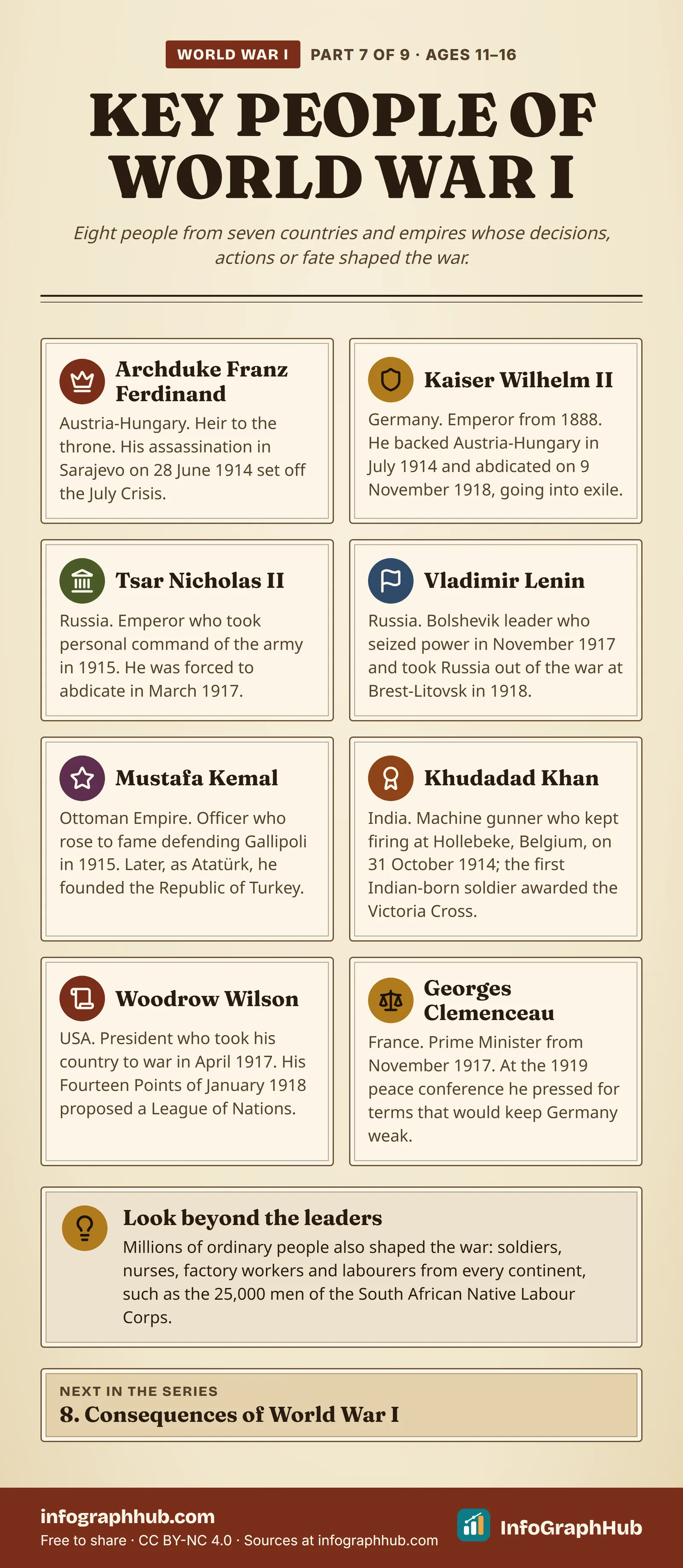
Eight people who shaped World War I, from emperors and revolutionaries to a front-line soldier: Franz Ferdinand, Wilhelm II, Nicholas II, Lenin, Mustafa Kemal, Khudadad Khan, Woodrow Wilson and Georges Clemenceau, each with a neutral one-line role.
Use this infographic
Free under CC BY-NC 4.0, with credit to InfoGraphHub.
Why study people?
IWM stresses that World War I was not an accident: it began, and was fought and ended, through decisions made by people. Studying individuals helps explain those decisions. It also shows that the war was experienced very differently by an emperor in Berlin, a revolutionary in Petrograd, an officer at Gallipoli and a soldier from the Punjab. The eight people on this infographic come from seven different countries and empires, and there were many more whose choices mattered.
Rulers who went to war
Archduke Franz Ferdinand was heir to the throne of Austria-Hungary. His assassination in Sarajevo on 28 June 1914 set off the July Crisis. Kaiser Wilhelm II, German Emperor since 1888, gave Austria-Hungary Germany's backing that July. As Germany's defeat became clear in autumn 1918, he lost support, and on 9 November he abdicated and went into exile in the Netherlands.
Tsar Nicholas II ruled Russia as an all-powerful monarch. In 1915 he took personal command of the army, which meant he was blamed for its defeats. Strikes, hunger and mutiny in Petrograd forced him to abdicate in March 1917, and in July 1918 he and his family were killed by the Bolsheviks.
Revolution and new nations
Vladimir Lenin led the Bolshevik party. He returned to Petrograd in April 1917, and on 7 November his Bolsheviks seized power. Determined to end Russia's part in the war, his government accepted the harsh Treaty of Brest-Litovsk in March 1918.
Mustafa Kemal was an Ottoman officer who became one of the leading figures in the defence of Gallipoli in 1915. After the war, under the name Atatürk, he led the movement that founded the modern Republic of Turkey from the ruins of the Ottoman Empire.
Soldiers and commanders
Khudadad Khan, a machine gunner with the 129th Duke of Connaught's Own Baluchis from the Punjab, kept firing his gun at Hollebeke in Belgium on 31 October 1914 after the rest of his team had been killed and he himself was wounded. He became the first Indian-born soldier to receive the Victoria Cross, Britain's highest award for bravery. He stands for about 1.5 million men who served in the Indian Army.
Among the generals, Ferdinand Foch of France became Commander-in-Chief of the Allied armies in March 1918 and led the Hundred Days Offensive. Douglas Haig commanded the British army on the Western Front, including at Passchendaele in 1917 and through the German attacks and Allied victories of 1918. In Germany, Paul von Hindenburg and Erich Ludendorff took over running the war from August 1916, and it was Ludendorff who told the Kaiser in September 1918 that the war was lost.
The peacemakers
Woodrow Wilson, President of the United States, asked Congress to declare war in April 1917. His Fourteen Points of January 1918 set out a fair peace and proposed a League of Nations. Georges Clemenceau, Prime Minister of France from November 1917, led his country to victory and then pressed for a peace that would keep Germany too weak to attack France again. With Britain's Prime Minister David Lloyd George and Italy's Prime Minister Vittorio Orlando, they formed the 'Big Four' who made the key decisions at the Paris Peace Conference in 1919.
Judging people fairly
Historians try to understand people in the context of their own time before judging them. Ask what each person knew, what pressures they faced and what choices they really had. Many people who shaped the war were never famous: about 25,000 men served in the South African Native Labour Corps by 1918, for example, including teachers and community leaders, building the roads and railways the armies depended on.
Frequently asked questions
Who were the most important people in World War I?
Key figures include Archduke Franz Ferdinand, whose assassination triggered the war; Kaiser Wilhelm II of Germany; Tsar Nicholas II and Lenin in Russia; Woodrow Wilson of the USA; Georges Clemenceau of France; David Lloyd George of Britain; and commanders such as Ferdinand Foch, Douglas Haig, Hindenburg, Ludendorff and Mustafa Kemal.
Who were the Big Four at the Paris Peace Conference?
David Lloyd George (Prime Minister of Britain), Georges Clemenceau (Prime Minister of France), Vittorio Orlando (Prime Minister of Italy) and Woodrow Wilson (President of the United States). Lloyd George, Clemenceau and Wilson are often called the Big Three.
Who was Khudadad Khan?
A machine gunner in the 129th Baluchis of the Indian Army. On 31 October 1914 at Hollebeke, Belgium, he kept his gun firing after the rest of his team had been killed and he was wounded. He was the first Indian-born soldier to be awarded the Victoria Cross.
What happened to Kaiser Wilhelm II at the end of the war?
He abdicated on 9 November 1918, two days before the Armistice, and went into exile in the Netherlands. Germany became a republic.
Sources & methodology
Every fact is checked against the sources below. We write original explanations and draw original graphics; no figures are copied from textbooks. Spotted an error? See our corrections policy.
- Outbreak of the First World War (Imperial War Museums (IWM), accessed 1 Oct 2026)
- Germany in the First World War (Imperial War Museums (IWM), accessed 1 Oct 2026)
- Russian February Revolution (Imperial War Museums (IWM), accessed 1 Oct 2026)
- Key Dates (National WWI Museum and Memorial, accessed 1 Oct 2026)
- First World War key battles (Imperial War Museums (IWM), accessed 1 Oct 2026)
- Life story: Khudadad Khan (Imperial War Museums, Lives of the First World War, accessed 1 Oct 2026)
- Paris Peace Conference (National WWI Museum and Memorial, accessed 1 Oct 2026)
- The Hundred Days Offensive (Imperial War Museums (IWM), accessed 1 Oct 2026)
- The South African Native Labour Corps: Segregation and racism in World War One (BBC Bitesize (KS3 History, with Imperial War Museums), accessed 1 Oct 2026)
Editorial review pending · Updated
Made by the InfoGraphHub editorial team (how we research and check: editorial and AI policy). First published 2 October 2026, last reviewed 1 October 2026. Found a mistake? Tell the editors.
For teachers: ages and curriculum fit
Ages 11–16 · Grades 6–10 (US) · Years 7–11 (UK) · Classes 6–10 (India)
Embed this on your site
Paste this HTML into your page. Keep the credit line: it is required by the CC BY-NC 4.0 license.
Related infographics


For teachers and parents: new InfoGraphHub resources by email
One short email when new free resources go live. For adults (18+) only. No spam, no tracking in emails, unsubscribe anytime.