FinanceNumbersPart 4 of 8, Compound Interest and SavingUpdated 1 October 2026
The Rule of 72: How Long Does Money Take to Double?
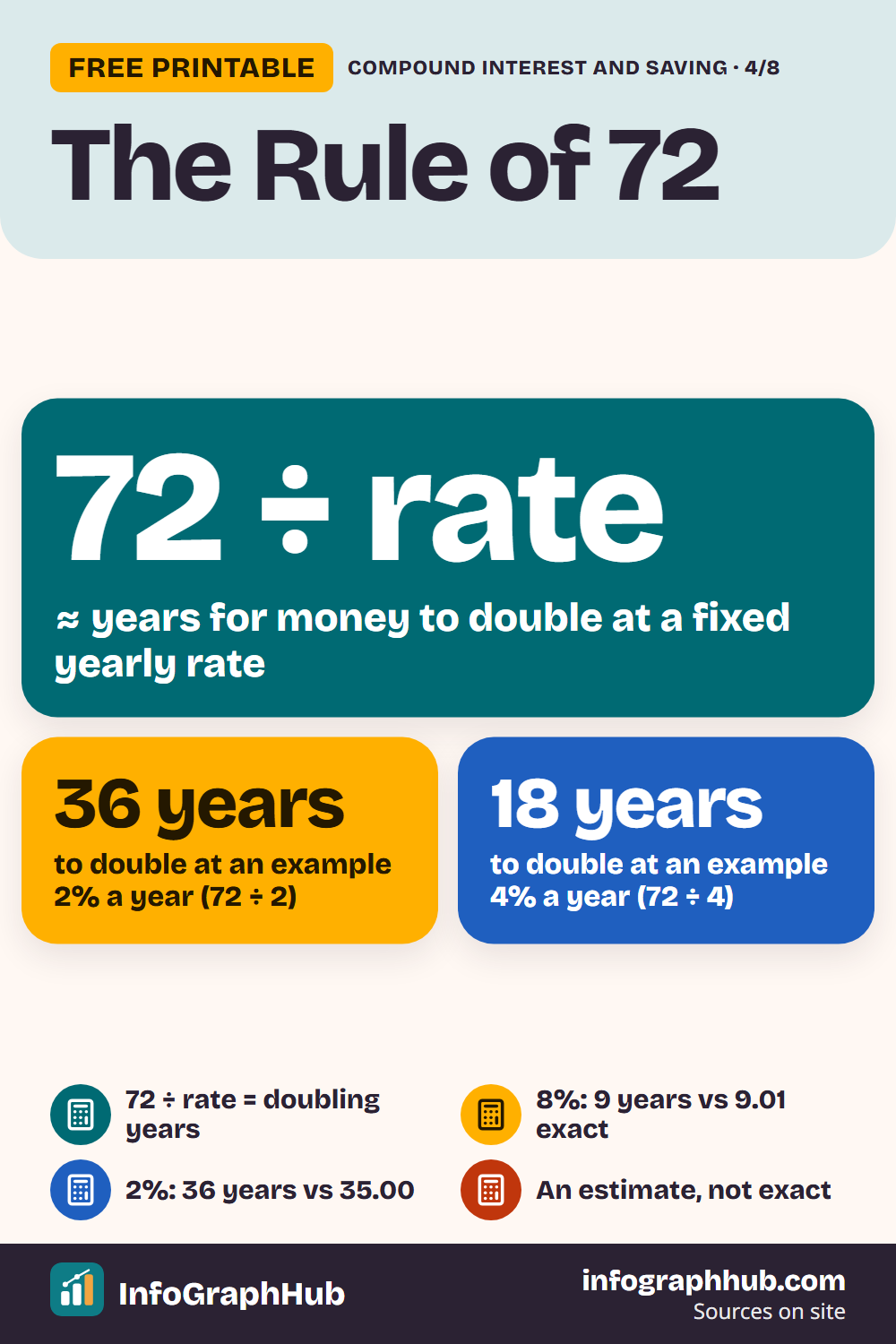
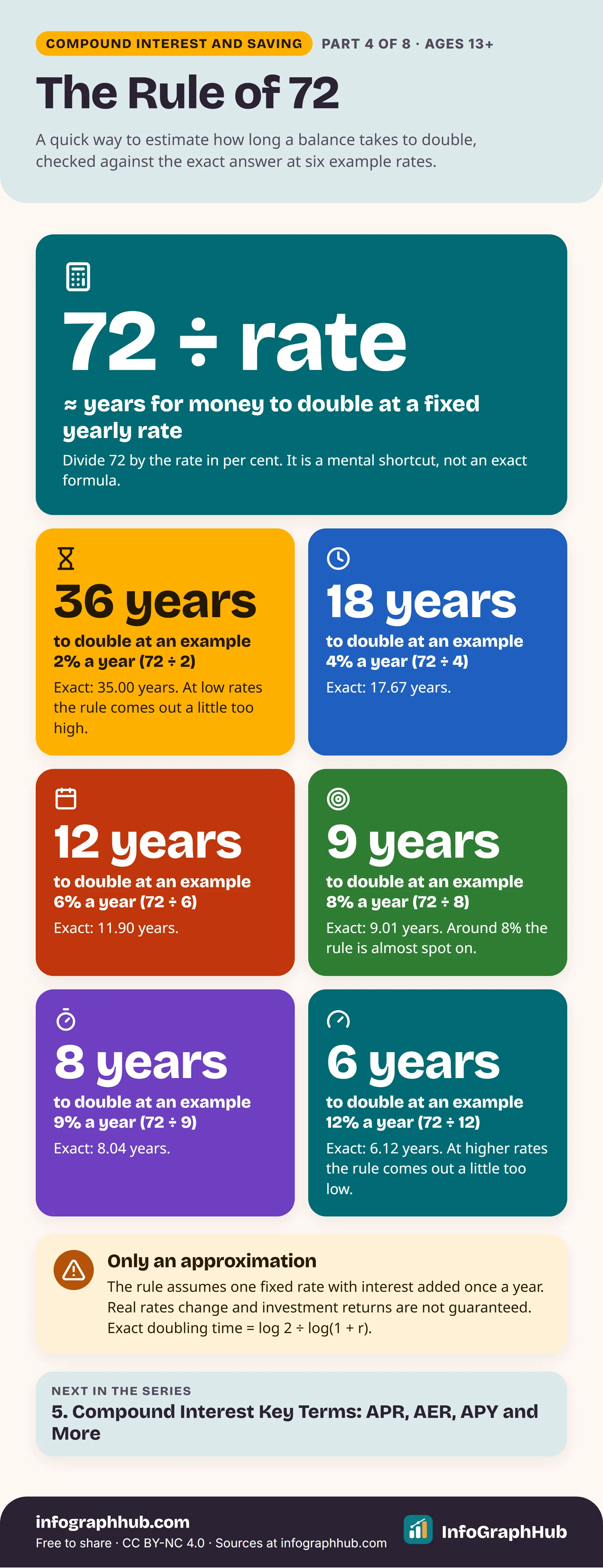
The Rule of 72 estimates doubling time by dividing 72 by the yearly rate. Its estimates at example rates of 2% to 12% sit beside the exact answers: 36 years against 35.00 at 2%, 9 against 9.01 at 8%, 6 against 6.12 at 12%.
Use this infographic
Free under CC BY-NC 4.0, with credit to InfoGraphHub.
What the Rule of 72 says
The Rule of 72 is a shortcut for compound growth. Divide 72 by the yearly interest rate (as a number of per cent, not a decimal), and the answer is roughly how many years it takes a balance to double.
At an example rate of 9% a year, 72 ÷ 9 = 8, so money doubles in about 8 years. That is the example the US Securities and Exchange Commission uses on Investor.gov. It works for any starting amount: 50, 1,000 and 1,000,000 all take the same time to double at the same rate.
How close is the estimate?
Here is the rule next to the exact answer, with interest added once a year:
| Example rate | Rule of 72 | Exact | Rule is off by |
|---|---|---|---|
| 2% | 36 years | 35.00 years | +1.00 year |
| 4% | 18 years | 17.67 years | +0.33 year |
| 6% | 12 years | 11.90 years | +0.10 year |
| 8% | 9 years | 9.01 years | −0.01 year |
| 9% | 8 years | 8.04 years | −0.04 year |
| 12% | 6 years | 6.12 years | −0.12 year |
Across these rates the rule is never more than 3% away from the true value. It is most accurate near 8%, a little too high at lower rates and a little too low at higher ones. It is an approximation: good for a quick check in your head, not for an exact answer.
Where the exact answer comes from
Money doubles when the multiplier reaches 2, so the exact doubling time t solves (1 + r)^t = 2, where r is the rate as a decimal. Taking logarithms of both sides gives:
t = log 2 ÷ log(1 + r)
At 8%: log 2 = 0.30103 and log 1.08 = 0.03342, so t = 0.30103 ÷ 0.03342 ≈ 9.01 years. Any base of logarithm works, as long as you use the same one on top and bottom.
There is one more subtlety. If interest is added only once a year, the balance jumps once a year. At 8%, 1,000 has grown to 1,999.00 after 9 years, just short of double, and passes 2,000 only when the year-10 interest is added.
Why 72?
Multiply each rate by its exact doubling time and you get the 'perfect' number for that rate: about 70.0 at 2%, 72.05 at 8% and 73.4 at 12%. So no single number is exact for every rate. 72 sits in the middle of the range people most often use, and it divides neatly by 1, 2, 3, 4, 6, 8, 9 and 12, which makes the mental arithmetic easy. Some people use 69 or 70 for very low rates, or when interest is added very often.
Other ways to use it
- Find a rate. To double money in 6 years you would need roughly 72 ÷ 6 = 12% a year (the exact figure is 12.25%).
- Prices. The rule works for anything that grows by a fixed percentage. At an example inflation rate of 3% a year, prices double in about 72 ÷ 3 = 24 years (exactly 23.45), so the same money buys about half as much.
- Debts. A debt left to grow at an example 12% a year, with nothing paid off, would double in about 6 years.
The rates on this page are examples to show how the maths works. This is financial education, not financial advice.
Frequently asked questions
What is the Rule of 72?
A quick way to estimate how long money takes to double with compound interest: divide 72 by the yearly rate in per cent. At an example rate of 6% a year, 72 ÷ 6 = 12, so money roughly doubles in 12 years.
Is the Rule of 72 exact?
No. It is an approximation. At 8% it gives 9 years against an exact 9.01, but at 2% it gives 36 years against an exact 35.00. For the exact answer use t = log 2 ÷ log(1 + r).
Why is it 72 and not 70 or 100?
The number that would make the rule exact changes with the rate, from about 70 at 2% to about 73 at 12%. 72 is close for common rates and divides easily by 2, 3, 4, 6, 8, 9 and 12.
Can the Rule of 72 be used for inflation?
Yes, for anything growing by a fixed percentage. At an example 3% inflation, prices double in about 72 ÷ 3 = 24 years (exactly 23.45), which means the same money would buy roughly half as much.
Sources & methodology
Every fact is checked against the sources below. We write original explanations and draw original graphics; no figures are copied from textbooks. Spotted an error? See our corrections policy.
- What is compound interest? (includes the Rule of 72) (Investor.gov, US Securities and Exchange Commission, accessed 1 Oct 2026)
- The rule of 72 for compound interest (Khan Academy, accessed 1 Oct 2026)
- High School: Functions » Linear, Quadratic, & Exponential Models (Common Core State Standards Initiative, accessed 1 Oct 2026)
Editorial review pending · Updated
Made by the InfoGraphHub editorial team (how we research and check: editorial and AI policy). First published 2 October 2026, last reviewed 1 October 2026. Found a mistake? Tell the editors.
For teachers: ages and curriculum fit
Ages 13+ · Grades 8–12 (US) · Years 9–13 (UK) · Classes 8–12 (India)
Common Core State Standards © Copyright 2010 National Governors Association Center for Best Practices and Council of Chief State School Officers. All rights reserved. Names and codes are used only to describe curriculum fit; InfoGraphHub is not endorsed by these organisations.
Embed this on your site
Paste this HTML into your page. Keep the credit line: it is required by the CC BY-NC 4.0 license.
Related infographics


For teachers and parents: new InfoGraphHub resources by email
One short email when new free resources go live. For adults (18+) only. No spam, no tracking in emails, unsubscribe anytime.