FinanceWorked examplePart 7 of 8, Compound Interest and SavingUpdated 1 October 2026
Common Compound Interest Mistakes and How to Avoid Them
Five common compound interest mistakes with the wrong working, the right working and why: adding the same interest every year, forgetting to turn % into a decimal, mixing yearly rates with monthly periods, comparing unlike rates and ignoring inflation.
Use this infographic
Free under CC BY-NC 4.0, with credit to InfoGraphHub.
Why compound interest mistakes happen
Compound interest uses only one formula, but it has four inputs that must agree with each other: the principal, the rate, how often interest is added and the time. Most mistakes come from one of those inputs being in the wrong form, or from treating a percentage as if it were a fixed amount.
Each mistake below uses example rates and amounts in any currency. The quickest defence against all of them is an estimate: work out roughly what the answer should be before you calculate it.
Adding instead of multiplying
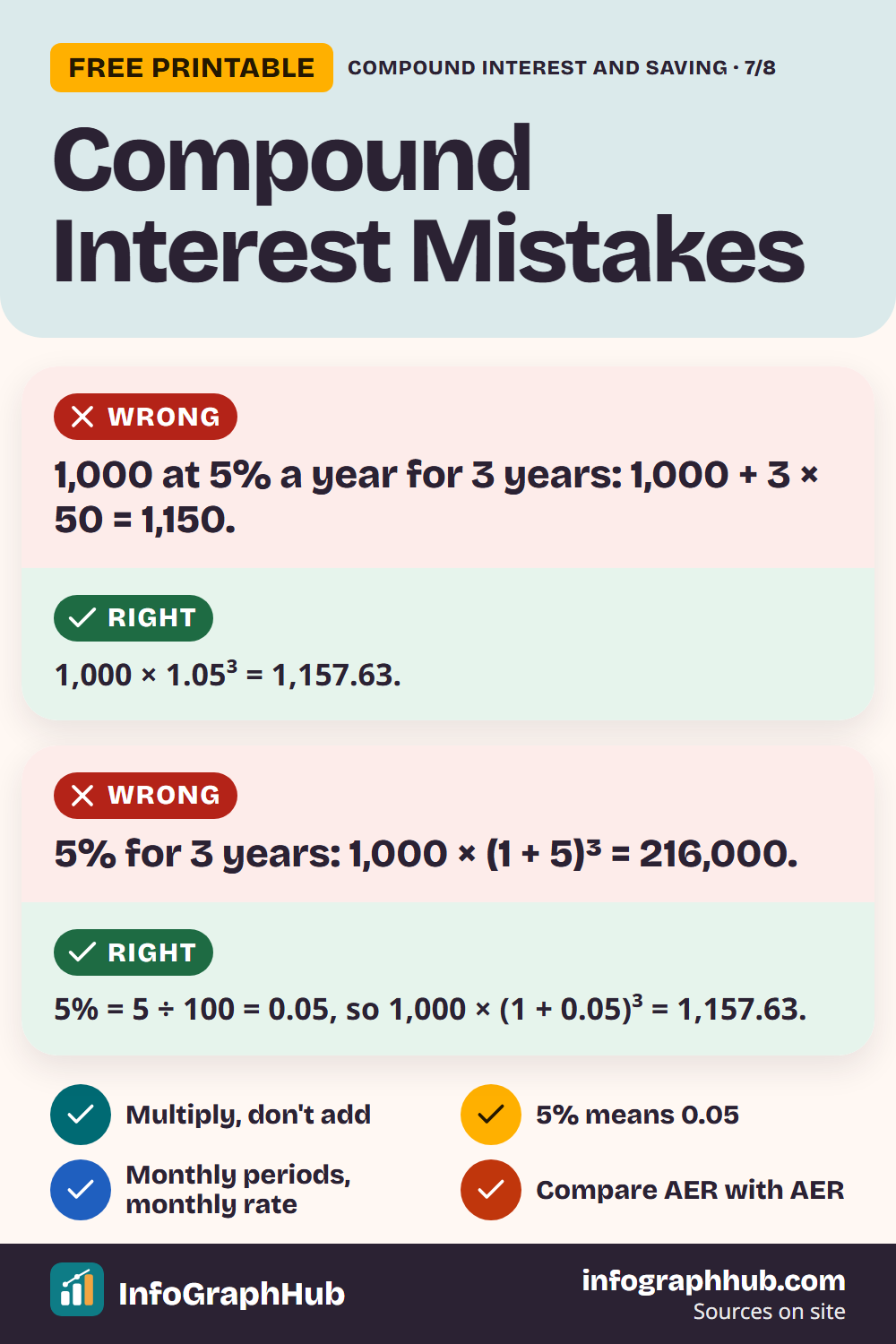
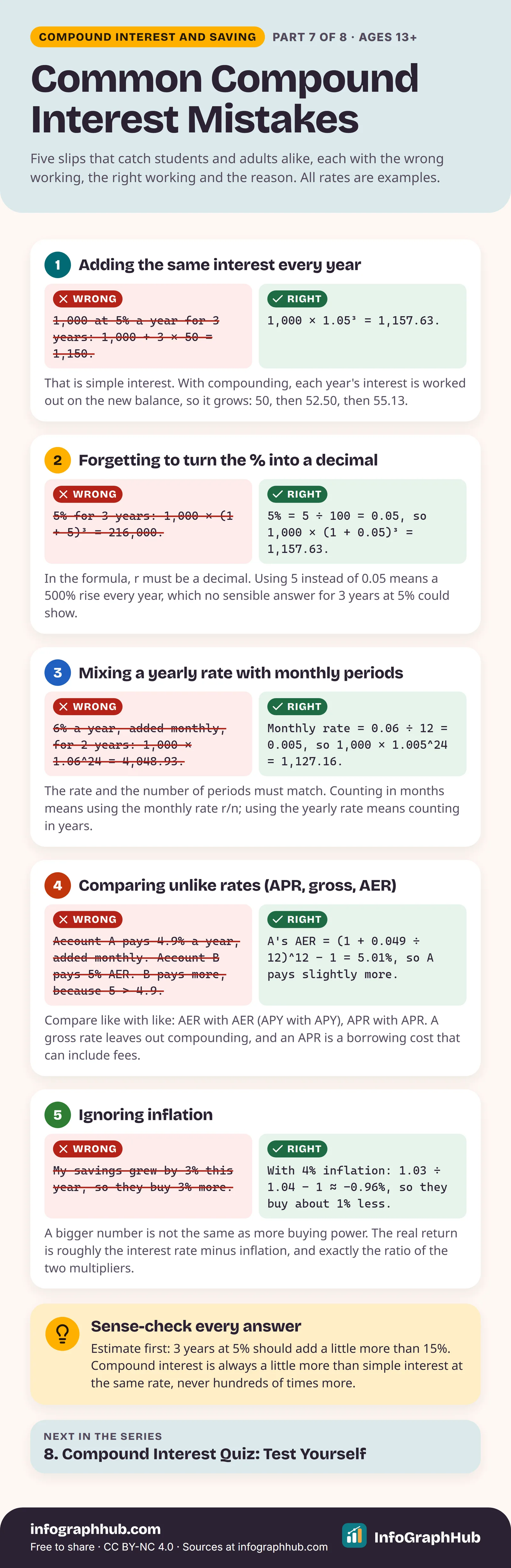
Adding 5% three times gives 15%, so it is tempting to write 1,000 + 150 = 1,150. That is the simple interest answer. With compounding, the second year's 5% is taken from 1,050 and the third year's from 1,102.50, so the true total is 1,157.63.
The same idea appears whenever percentages are applied one after another: the changes multiply, they do not add. Two 5% increases make 1.05 × 1.05 = 1.1025, a 10.25% increase, not 10%.
Getting the rate into the right form
The formula A = P(1 + r/n)^(nt) needs r as a decimal: 5% is 0.05 and 0.5% is 0.005. Typing 5 instead of 0.05 turns the multiplier from 1.05 into 6, which means the money grows six times over every year. The result, 216,000 from 1,000 in three years, should look obviously wrong, and checking for that is a habit worth building.
The second trap is matching the rate to the period. A rate quoted per year must be divided by n when interest is added n times a year, and the time must then be counted in periods, n × t. Using the yearly 6% with 24 monthly periods is the same as pretending the money earned 6% every month.
Comparing rates that are measured differently
A gross or nominal rate is the headline yearly figure. An AER (UK) or APY (US) shows what that rate is worth over a year once compounding is included. If one account adds interest monthly and another yearly, only their AERs can be compared directly. In the example, 4.9% added monthly works out at an AER of 5.01%, just above the 5% account.
An APR is a different kind of figure again: it shows the yearly cost of borrowing and often includes fees. It belongs with other APRs, not with savings rates. When two rates look close, check which kind each one is before deciding which is bigger.
Forgetting what money can buy
If prices rise faster than a balance grows, the saver ends up able to buy less, even though the number in the account went up. With 3% interest and an example 4% inflation, the real return is 1.03 ÷ 1.04 − 1 ≈ −0.96%. The shortcut 3% − 4% = −1% gives almost the same answer.
These corrections are about getting the maths right. This page is financial education, not financial advice.
Frequently asked questions
What is the most common compound interest mistake?
Treating it like simple interest: adding the same amount of interest every year instead of working out each year's interest on the new, bigger balance. For 1,000 at 5% for 3 years, that gives 1,150 instead of the correct 1,157.63.
Do I use 5 or 0.05 in the compound interest formula?
Use 0.05. The rate r in A = P(1 + r/n)^(nt) must be a decimal, so divide the percentage by 100 first. Using 5 makes the multiplier 6 instead of 1.05 and gives an answer that is far too big.
How do I use a yearly rate when interest is added monthly?
Divide the yearly rate by 12 to get the monthly rate and count the time in months. An example 6% a year becomes 0.5% a month, so 2 years is 1.005 to the power 24, not 1.06 to the power 24.
Why can't I compare an APR with an AER?
They measure different things. An APR shows the yearly cost of borrowing and often includes fees; an AER shows the yearly interest on savings including compounding. Compare APRs with APRs and AERs with AERs.
Sources & methodology
Every fact is checked against the sources below. We write original explanations and draw original graphics; no figures are copied from textbooks. Spotted an error? See our corrections policy.
- Repeated percentage change, interest and exponential change (BBC Bitesize, accessed 1 Oct 2026)
- Annual Equivalent Rate (AER) Practice Note (January 2025) (UK Finance and the Building Societies Association, accessed 1 Oct 2026)
- What is the difference between a loan's interest rate and its APR? (US Consumer Financial Protection Bureau, accessed 1 Oct 2026)
- What is inflation? (Bank of England, accessed 1 Oct 2026)
Editorial review pending · Updated
Made by the InfoGraphHub editorial team (how we research and check: editorial and AI policy). First published 2 October 2026, last reviewed 1 October 2026. Found a mistake? Tell the editors.
For teachers: ages and curriculum fit
Ages 13+ · Grades 8–12 (US) · Years 9–13 (UK) · Classes 8–12 (India)
Common Core State Standards © Copyright 2010 National Governors Association Center for Best Practices and Council of Chief State School Officers. All rights reserved. Names and codes are used only to describe curriculum fit; InfoGraphHub is not endorsed by these organisations.
Embed this on your site
Paste this HTML into your page. Keep the credit line: it is required by the CC BY-NC 4.0 license.
Related infographics


For teachers and parents: new InfoGraphHub resources by email
One short email when new free resources go live. For adults (18+) only. No spam, no tracking in emails, unsubscribe anytime.