FinanceCheat sheetPart 5 of 8, Compound Interest and SavingUpdated 1 October 2026
Compound Interest Key Terms: APR, AER, APY and More
A cheat sheet of 14 compound interest key terms with one-line meanings: principal, rate, period, compounding frequency and the formula, then APR, AER and APY (two names for one idea), fixed and variable rates, inflation and real return.
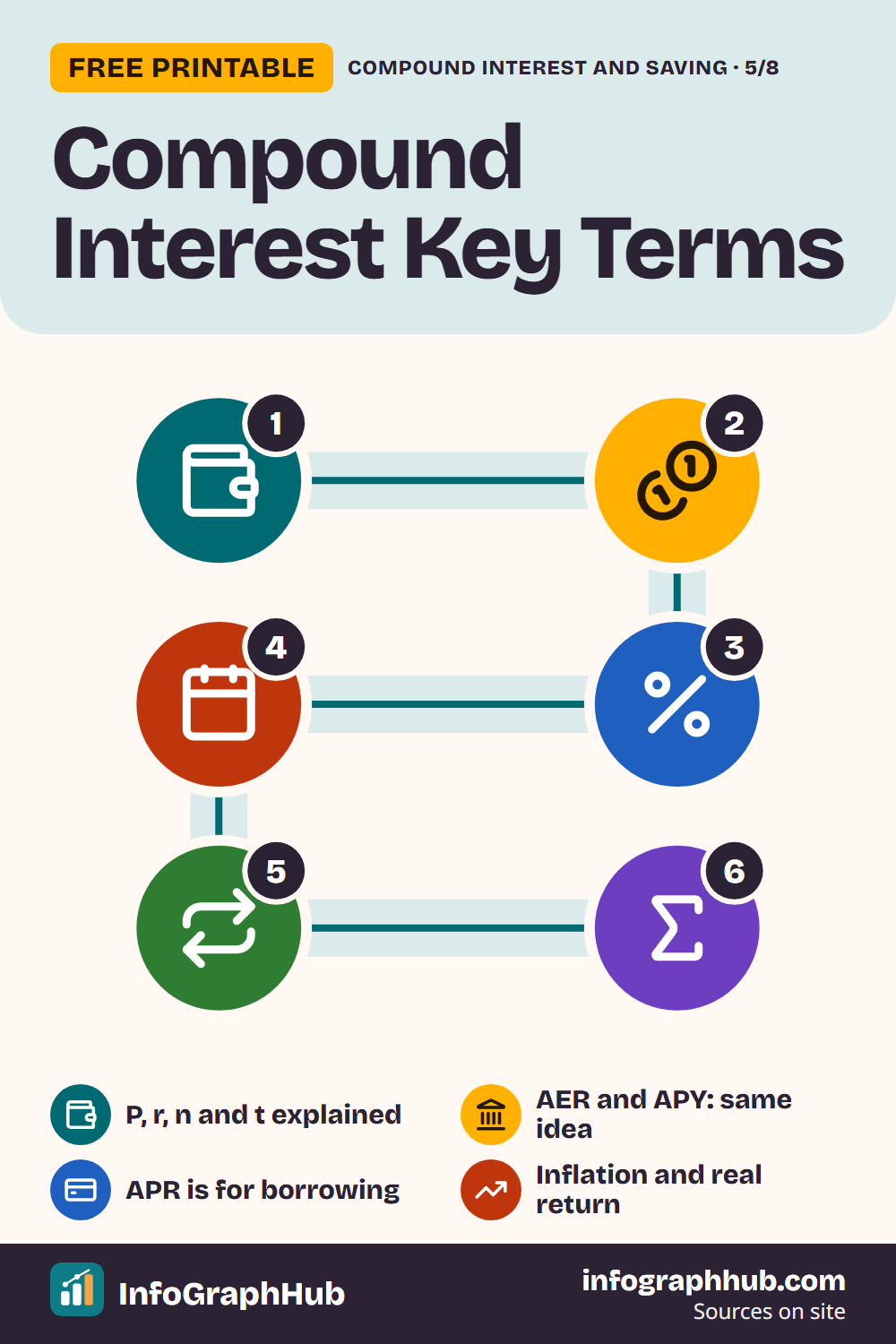
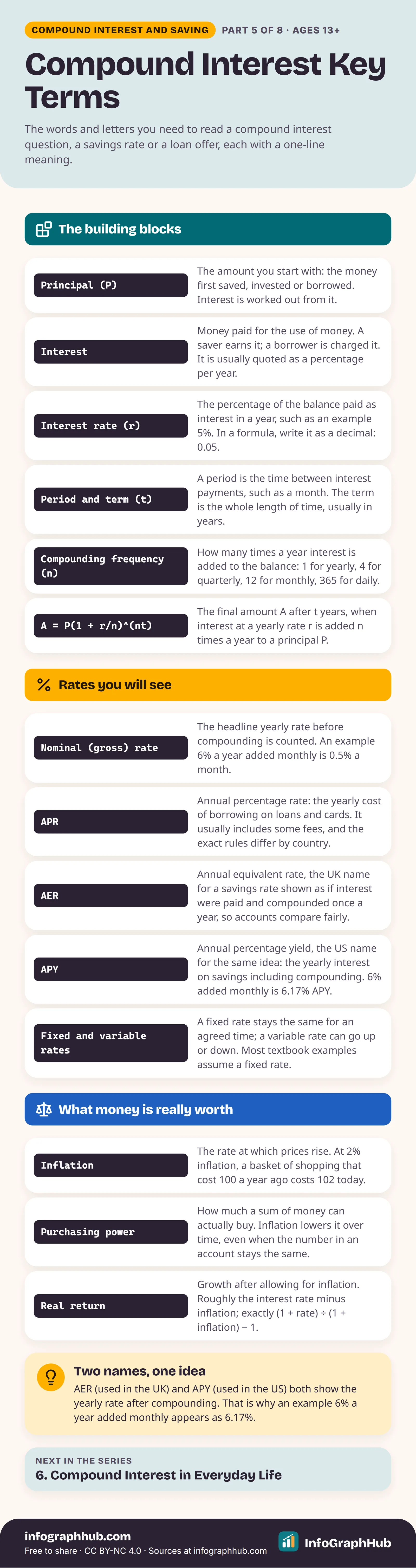
Use this infographic
Free under CC BY-NC 4.0, with credit to InfoGraphHub.
Why the exact words matter
The same account or loan can be described with several different numbers. A savings rate might be quoted as a gross rate, an AER or an APY; a loan comes with an APR. Each number measures something slightly different, so knowing the words is the first step to comparing offers fairly and to reading exam questions correctly.
This cheat sheet sorts the terms into three groups: the building blocks of every calculation, the rates you see on accounts and loans, and what money is really worth once rising prices are counted.
The letters in the formula
Every compound interest formula uses the same few letters:
| Letter | Meaning | Example |
|---|---|---|
| P | Principal, the starting amount | 1,000 |
| r | Yearly rate as a decimal | 6% → 0.06 |
| n | Times interest is added each year | monthly → 12 |
| t | Time in years | 3 |
| A | Final amount | 1,196.68 |
Two combinations are worth remembering: r/n is the rate for one period, and nt is the number of periods. Part 2 of this series works through the formula step by step.
Gross rate, AER and APY
A nominal or gross rate is the headline yearly figure. If interest is added more than once a year, the balance actually grows by a little more than that figure, because each payment starts earning interest straight away.
AER and APY fix this by showing what the yearly rate works out to after compounding. They are two names for the same idea: AER (annual equivalent rate) is the term UK banks use, and APY (annual percentage yield) is the term US banks use. With an example 6% a year added monthly, 1,000 earns 61.68 in a year, so the AER or APY is 6.17%. If interest is only added once a year, the gross rate and the AER are the same.
APR for borrowing
APR (annual percentage rate) is the figure quoted for loans and credit cards. The US Consumer Financial Protection Bureau describes a loan's APR as the interest rate plus certain fees charged by the lender, which makes it a fuller measure of the cost than the interest rate alone. Exactly what is included, and whether compounding is built in, depends on the country's rules and the product. For example, many US card issuers divide the APR by 365 (or 360) to get a daily rate and add interest to the balance every day, so an unpaid balance grows a little faster than the APR alone suggests. Compare APRs with other APRs, and savings AERs or APYs with each other.
Inflation and real return
Inflation is the rate at which prices rise. The Bank of England gives a simple picture: at 2% inflation, a basket of goods that cost 100 a year ago costs 102 now.
What matters to a saver is the real return: how much more the money can buy, not just how much bigger the number is. A quick estimate is the interest rate minus inflation. With example figures of 5% interest and 3% inflation, that gives about 2%. The exact figure is 1.05 ÷ 1.03 − 1 = 1.94%. If inflation is higher than the interest rate, the real return is negative and the money buys less each year.
This cheat sheet is financial education about the words and the maths, not financial advice.
Frequently asked questions
What is the difference between AER and APY?
There is no real difference in meaning. Both show the yearly interest on savings after compounding is counted. AER (annual equivalent rate) is the term used in the UK; APY (annual percentage yield) is the term used in the US.
What is the difference between APR and AER?
APR is used for borrowing and shows the yearly cost of a loan or card, usually including some fees. AER is used for savings and shows the yearly interest as if it were paid and compounded once a year. They measure different things, so compare APR with APR and AER with AER.
What does principal mean in compound interest?
The principal is the starting amount of money: what you first save, invest or borrow. In the formula A = P(1 + r/n)^(nt) it is the letter P.
What is a real return?
It is how much your money grows after allowing for inflation. Roughly, it is the interest rate minus the inflation rate. With 5% interest and 3% inflation, the real return is about 2% (exactly 1.94%).
Sources & methodology
Every fact is checked against the sources below. We write original explanations and draw original graphics; no figures are copied from textbooks. Spotted an error? See our corrections policy.
- Annual Equivalent Rate (AER) Practice Note (January 2025) (UK Finance and the Building Societies Association, accessed 1 Oct 2026)
- Appendix A to Part 1030 (Regulation DD): Annual Percentage Yield Calculation (US Consumer Financial Protection Bureau, accessed 1 Oct 2026)
- What is the difference between a loan's interest rate and its APR? (US Consumer Financial Protection Bureau, accessed 1 Oct 2026)
- What is a "daily periodic rate" on a credit card? (US Consumer Financial Protection Bureau, accessed 1 Oct 2026)
- What is inflation? (Bank of England, accessed 1 Oct 2026)
- Interest rates explained (MoneyHelper (UK Money and Pensions Service), accessed 1 Oct 2026)
Editorial review pending · Updated
Made by the InfoGraphHub editorial team (how we research and check: editorial and AI policy). First published 2 October 2026, last reviewed 1 October 2026. Found a mistake? Tell the editors.
For teachers: ages and curriculum fit
Ages 13+ · Grades 8–12 (US) · Years 9–13 (UK) · Classes 8–12 (India)
Embed this on your site
Paste this HTML into your page. Keep the credit line: it is required by the CC BY-NC 4.0 license.
Related infographics


For teachers and parents: new InfoGraphHub resources by email
One short email when new free resources go live. For adults (18+) only. No spam, no tracking in emails, unsubscribe anytime.