solar system infographics
Every InfoGraphHub infographic tagged “solar system”.
 Science
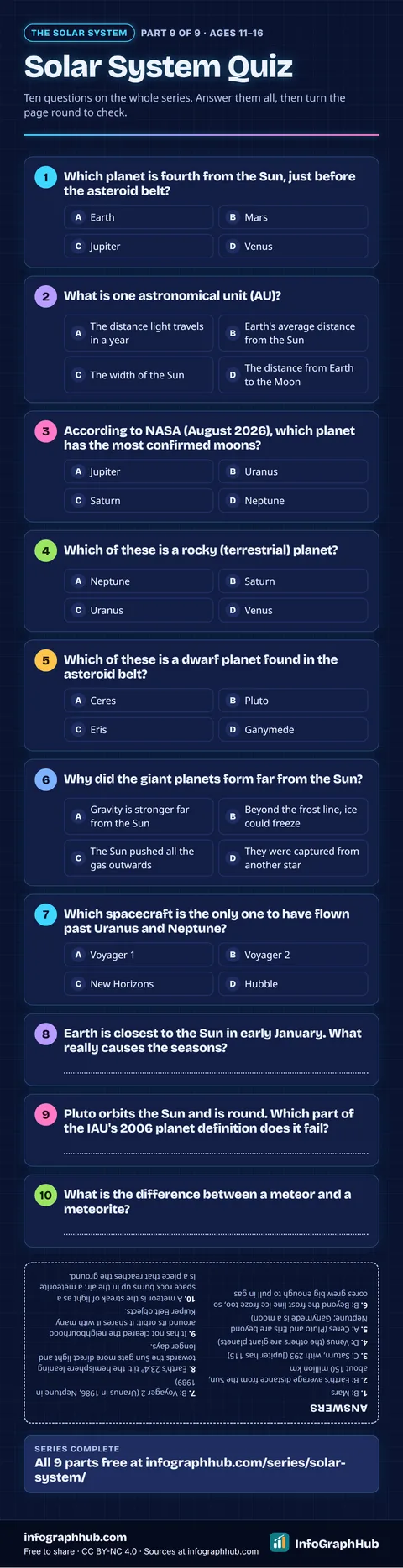
Solar System Quiz: Test Yourself
Ten questions on the whole Solar System series: the order of the planets, distances in AU, rocky and giant planets, dwarf planets, comets, how the Solar System formed, famous missions and common myths. Answers are printed upside down.
 Science
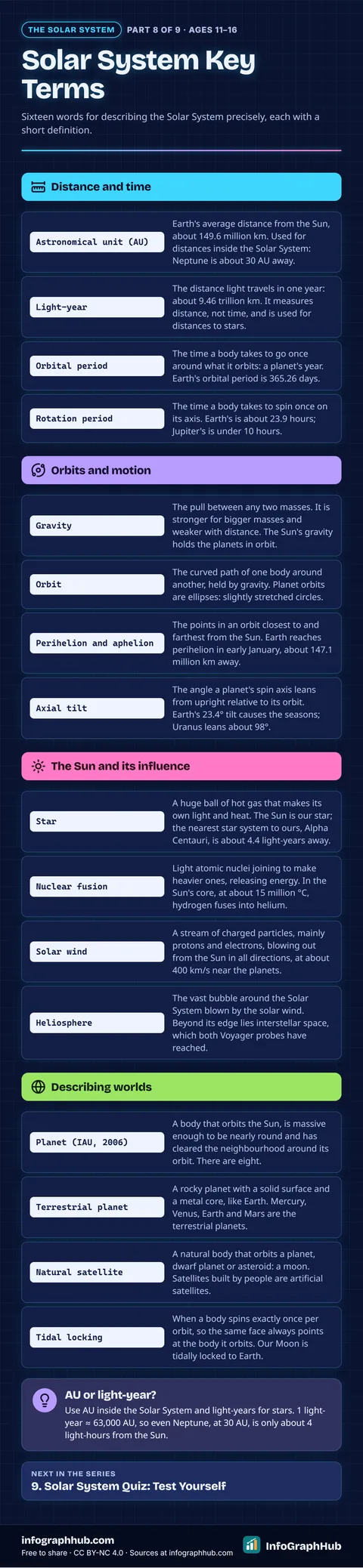
Solar System Key Terms
The 16 words you need to describe the Solar System precisely, from astronomical unit and light-year to orbit, axial tilt, perihelion, solar wind, heliosphere and tidal locking, each with a short, exact definition.
 Science
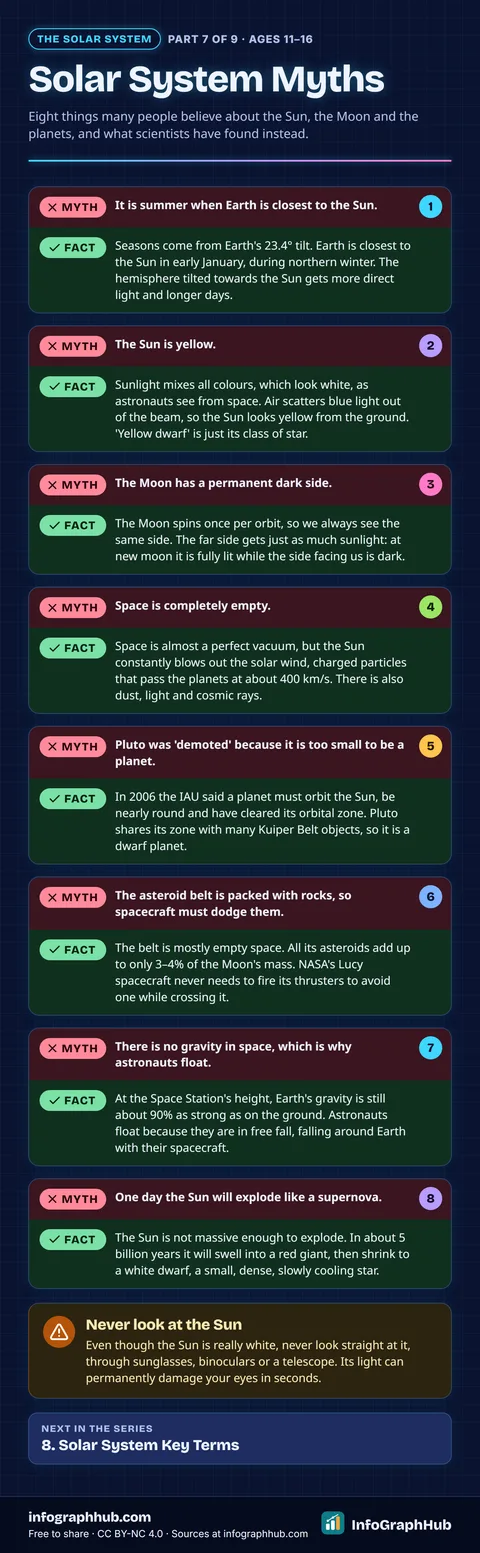
Solar System Myths and the Real Science
Eight common Solar System myths, corrected with evidence: seasons are not caused by distance from the Sun, the Sun is white, the Moon has no permanent dark side, space is not empty, and Pluto was not reclassified for being small.
 Science
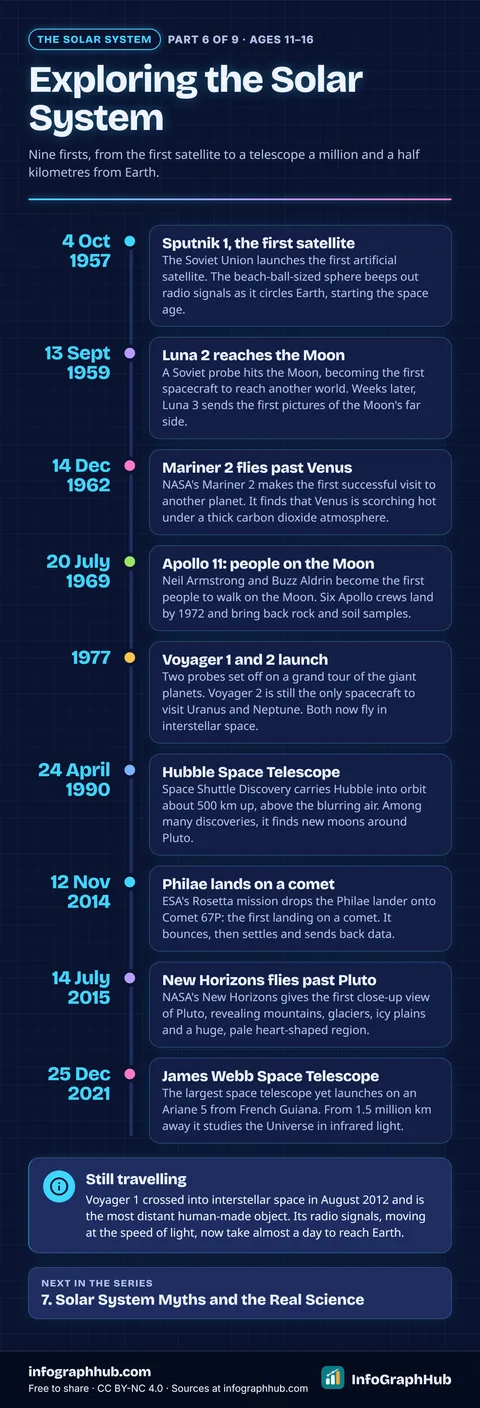
Exploring the Solar System: A Timeline
From Sputnik's first orbit in 1957 to the James Webb Space Telescope in 2021: nine milestones in exploring the Solar System, including the first Moon landing, the Voyager probes, Hubble, a landing on a comet and a flyby of Pluto.
 Science
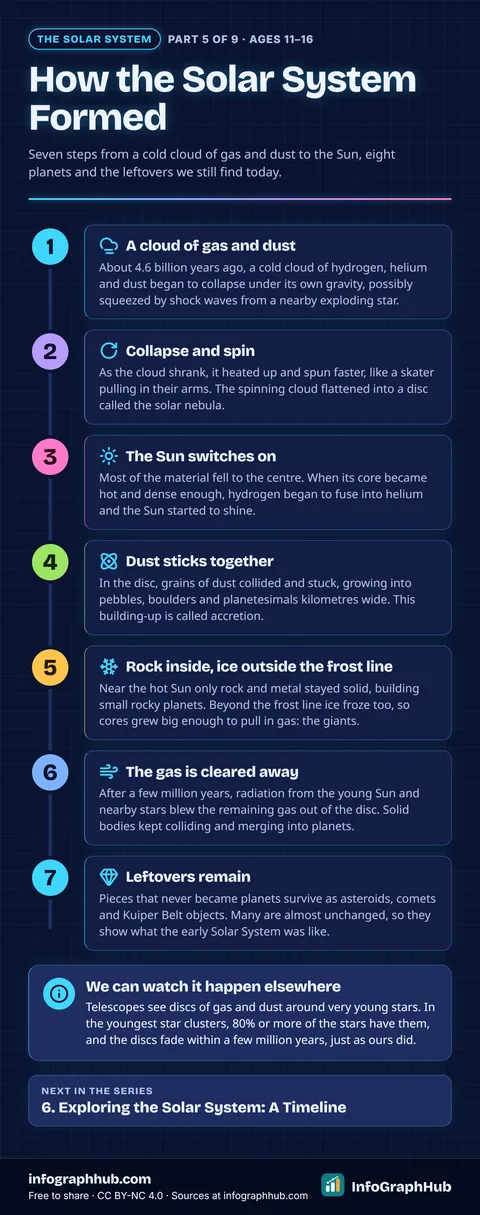
How the Solar System Formed
About 4.6 billion years ago a cloud of gas and dust collapsed. Its centre became the Sun, and a spinning disc around it built the planets: rocky worlds near the Sun, giants beyond the frost line, and leftovers we still see today.
 Science
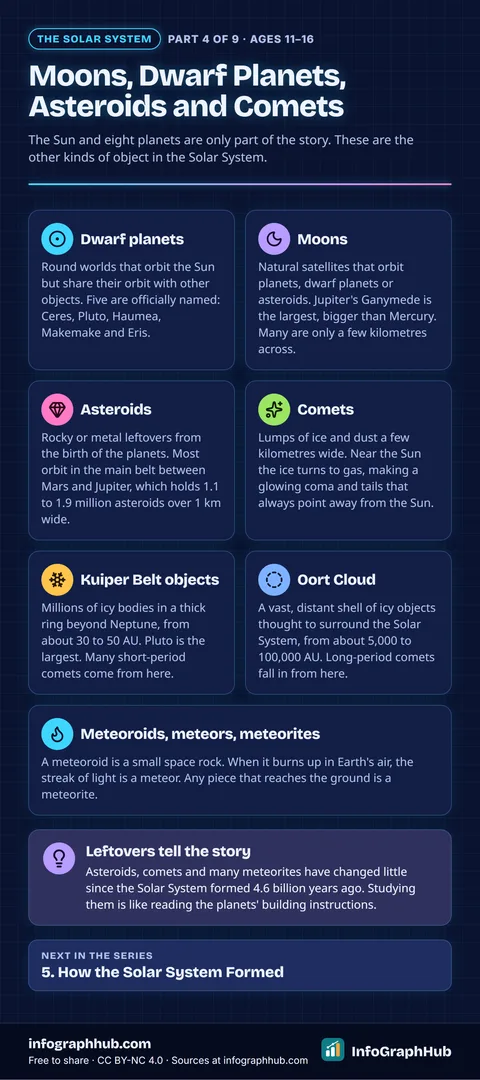
Moons, Dwarf Planets, Asteroids and Comets
The Solar System is far more than the Sun and eight planets. Meet the other kinds of object that orbit the Sun: dwarf planets, moons, asteroids, comets, Kuiper Belt objects and the meteoroids that become shooting stars.
 Science
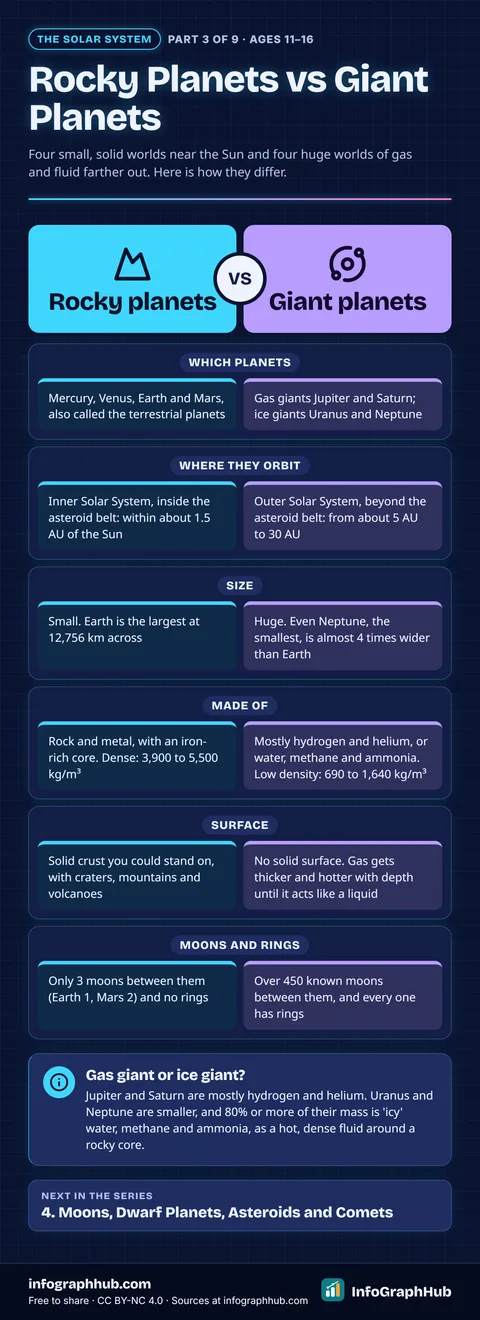
Rocky Planets vs Giant Planets
The Solar System has two families of planets. Four small rocky planets close to the Sun have solid surfaces and few moons; four giant planets farther out are made mostly of gas and fluid, with rings and hundreds of moons.
 Science
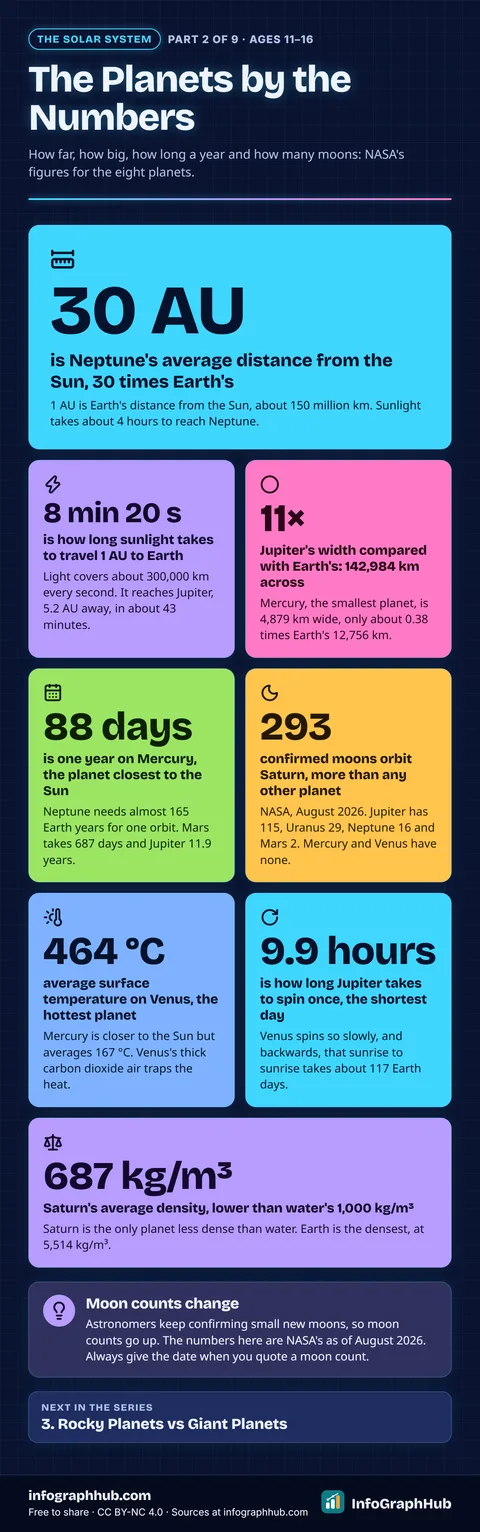
The Planets by the Numbers
How far, how big, how long a year and how many moons? NASA's figures for all eight planets: distances in astronomical units, diameters, orbit times and moon counts, from Mercury's 88-day year to Saturn's 293 known moons.
 Science
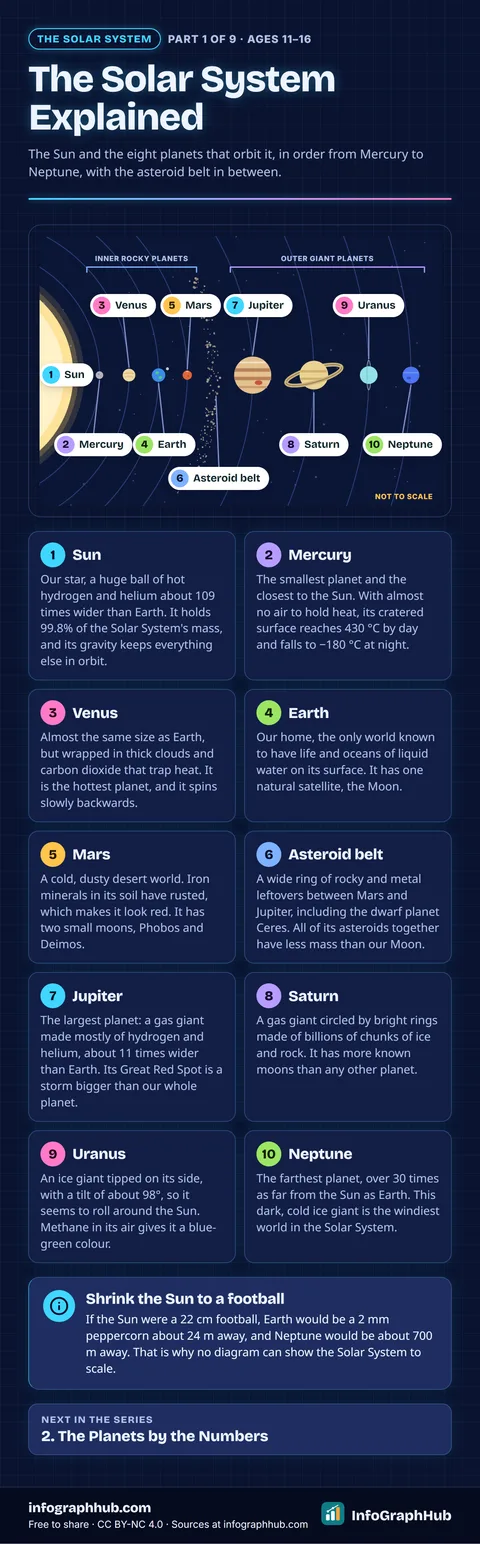
The Solar System Explained
The Solar System is the Sun and everything its gravity holds in orbit: eight planets from Mercury to Neptune, their moons, dwarf planets, asteroids and comets. Meet each planet in order, with the asteroid belt between Mars and Jupiter.