Science, spaceComparisonPart 3 of 9, The Solar SystemUpdated 1 October 2026
Rocky Planets vs Giant Planets
The Solar System has two families of planets. Four small rocky planets close to the Sun have solid surfaces and few moons; four giant planets farther out are made mostly of gas and fluid, with rings and hundreds of moons.
Interactive
Explore it step by step
- Which planets
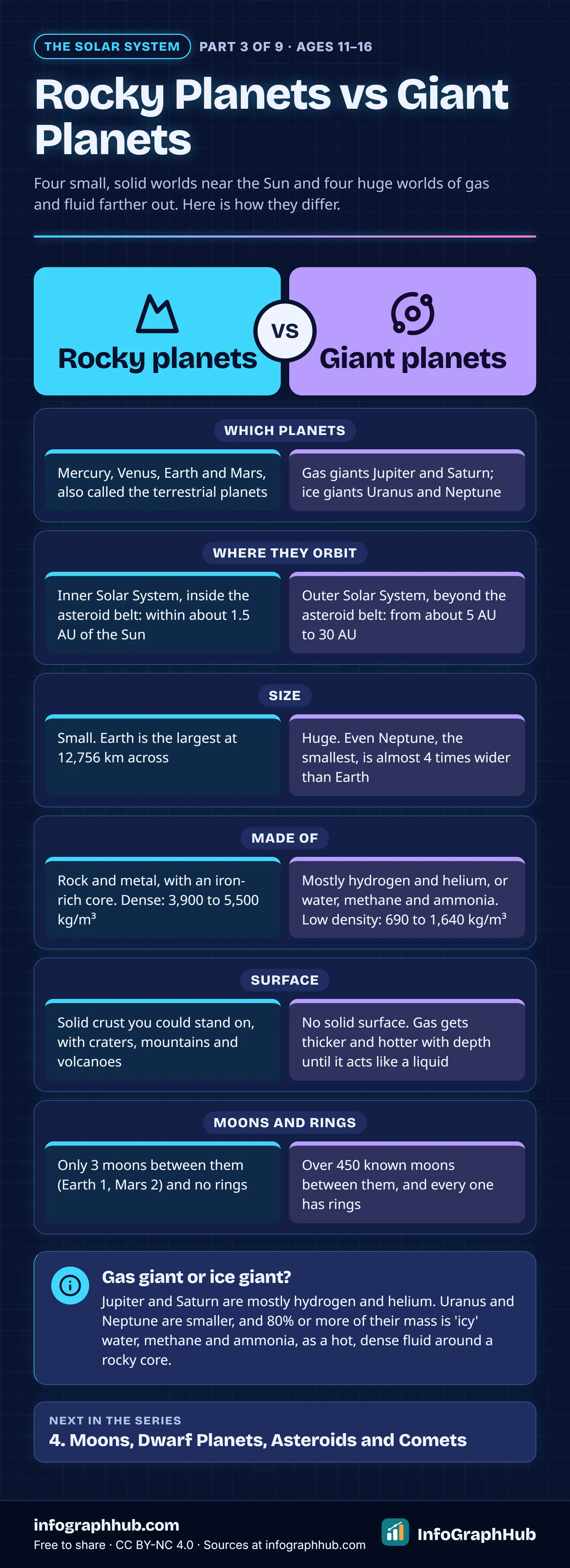
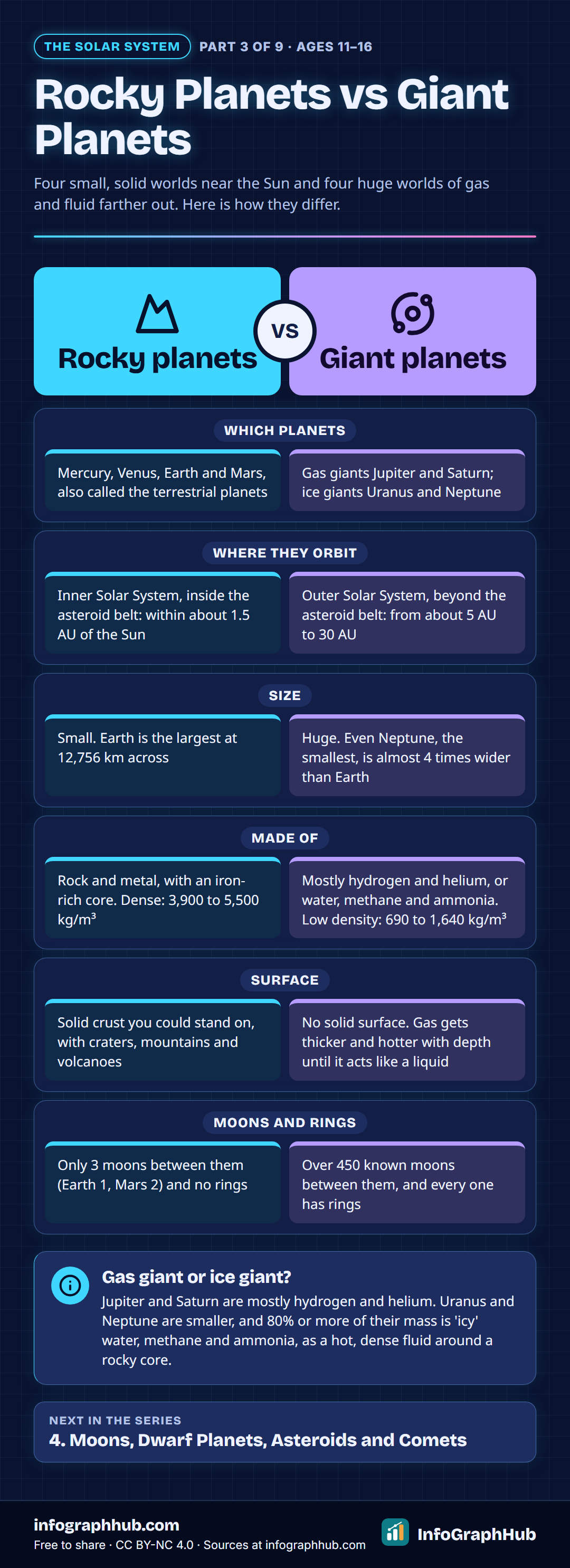
Rocky planets: Mercury, Venus, Earth and Mars, also called the terrestrial planets
Giant planets: Gas giants Jupiter and Saturn; ice giants Uranus and Neptune
- Where they orbit
Rocky planets: Inner Solar System, inside the asteroid belt: within about 1.5 AU of the Sun
Giant planets: Outer Solar System, beyond the asteroid belt: from about 5 AU to 30 AU
- Size
Rocky planets: Small. Earth is the largest at 12,756 km across
Giant planets: Huge. Even Neptune, the smallest, is almost 4 times wider than Earth
- Made of
Rocky planets: Rock and metal, with an iron-rich core. Dense: 3,900 to 5,500 kg/m³
Giant planets: Mostly hydrogen and helium, or water, methane and ammonia. Low density: 690 to 1,640 kg/m³
- Surface
Rocky planets: Solid crust you could stand on, with craters, mountains and volcanoes
Giant planets: No solid surface. Gas gets thicker and hotter with depth until it acts like a liquid
- Moons and rings
Rocky planets: Only 3 moons between them (Earth 1, Mars 2) and no rings
Giant planets: Over 450 known moons between them, and every one has rings
Use this infographic
Free under CC BY-NC 4.0, with credit to InfoGraphHub.
Two families of planets
The eight planets split neatly into two groups, with the asteroid belt as the dividing line.
- The rocky planets, also called terrestrial planets (from terra, Latin for 'earth'): Mercury, Venus, Earth and Mars. They are the four inner planets.
- The giant planets: Jupiter, Saturn, Uranus and Neptune, the four outer planets. Jupiter and Saturn are gas giants; Uranus and Neptune are ice giants.
The two families differ in almost every way: size, what they are made of, whether they have a surface, how many moons they have and whether they have rings. The split is not an accident. It records where each planet formed in the young Solar System and what materials were available there.
Rocky planets: small, dense and solid
Each rocky planet has layers: a metal core, rich in iron, a rocky mantle and a thin solid crust. You could, in principle, stand on any of them, although Venus's surface is hot enough to melt lead.
Rock and metal are heavy materials, so these planets are dense. NASA's Planetary Fact Sheet gives densities from 3,934 kg/m³ for Mars to 5,514 kg/m³ for Earth, the densest planet. Water, for comparison, is 1,000 kg/m³.
They are also small. Earth is the largest at 12,756 km across, and Mercury is only 4,879 km. Between them, the four rocky planets have just three moons: our Moon and Mars's two tiny moons, Phobos and Deimos. None of them has rings.
Gas giants: Jupiter and Saturn
Jupiter and Saturn are made mostly of hydrogen and helium, the same light gases that make up most of the Sun. They have no solid surface. Going down into Jupiter, the gas gets hotter and more squashed until it behaves like a liquid, a deep ocean of hydrogen above a fuzzy core.
Because they are made of such light materials, the gas giants have low densities even though they are huge. Saturn's average density is only 687 kg/m³, less than water's.
Ice giants: Uranus and Neptune
Uranus and Neptune are smaller than the gas giants and made of different stuff. NASA explains that 80 per cent or more of Uranus's mass is a hot, dense fluid of 'icy' materials, mainly water, methane and ammonia, above a small rocky core. Astronomers call these materials ices because they formed as frozen solids far from the Sun, even though inside the planet they are hot fluids, not ice cubes.
Their outer atmospheres are mostly hydrogen and helium with some methane. Methane absorbs red light, which helps give both planets their blue colours.
Why the two families are different
When the planets were forming about 4.6 billion years ago, it was too hot close to the young Sun for ices to stay solid. Only rock and metal could gather there, and there was not much of it, so the inner planets stayed small. Farther out, beyond what scientists call the frost line, ices could freeze as well, so much more solid material was available. The cores of the outer planets grew large enough for their gravity to pull in huge amounts of gas. How the Solar System Formed, Part 5 of this series, follows the full story.
Worked comparison: Earth and Jupiter
Jupiter is about 11.2 times wider than Earth. Volume grows with the cube of width, so Jupiter's volume is about 11.2 × 11.2 × 11.2 ≈ 1,400 times Earth's. Its mass, though, is only about 318 times Earth's. More than 1,400 times the space but only 318 times the mass means each cubic metre of Jupiter holds much less matter, so Jupiter's density is about a quarter of Earth's: 1,326 kg/m³ compared with 5,514 kg/m³.
Frequently asked questions
What is the difference between rocky planets and gas giants?
Rocky (terrestrial) planets are small and dense, with a metal core, a rocky mantle and a solid surface. Gas giants are huge and made mostly of hydrogen and helium, with no solid surface, many moons and rings.
Which planets are the terrestrial planets?
Mercury, Venus, Earth and Mars, the four inner planets. They are called terrestrial because, like Earth, they have solid, rocky surfaces.
What is the difference between a gas giant and an ice giant?
Gas giants (Jupiter and Saturn) are mostly hydrogen and helium. Ice giants (Uranus and Neptune) are smaller, and most of their mass is a hot, dense fluid of water, methane and ammonia above a small rocky core.
Why are the inner planets rocky and the outer planets giants?
Close to the young Sun it was too hot for ice to freeze, so only rock and metal could build planets. Farther out, ice was also available, so cores grew big enough to pull in large amounts of hydrogen and helium gas.
Sources & methodology
Every fact is checked against the sources below. We write original explanations and draw original graphics; no figures are copied from textbooks. Spotted an error? See our corrections policy.
- Planets (NASA Science, accessed 1 Oct 2026)
- Planetary Fact Sheet (Metric) (NASA Goddard Space Flight Center (NSSDCA), accessed 1 Oct 2026)
- Uranus: Facts (NASA Science, accessed 1 Oct 2026)
- Jupiter: Facts (NASA Science, accessed 1 Oct 2026)
- Mars: Facts (NASA Science, accessed 1 Oct 2026)
- How our solar system was born (Natural History Museum, London, accessed 1 Oct 2026)
Editorial review pending · Updated
Made by the InfoGraphHub editorial team (how we research and check: editorial and AI policy). First published 2 October 2026, last reviewed 1 October 2026. Found a mistake? Tell the editors.
For teachers: ages and curriculum fit
Ages 11–16 · Grades 6–10 (US) · Years 7–11 (UK) · Classes 6–10 (India)
NGSS is a registered trademark of WestEd. Names and codes are used only to describe curriculum fit; InfoGraphHub is not endorsed by these organisations.
Embed this on your site
Paste this HTML into your page. Keep the credit line: it is required by the CC BY-NC 4.0 license.
Related infographics


For teachers and parents: new InfoGraphHub resources by email
One short email when new free resources go live. For adults (18+) only. No spam, no tracking in emails, unsubscribe anytime.