Science, spaceLabelled diagramPart 1 of 9, The Solar SystemUpdated 1 October 2026
The Solar System Explained
The Solar System is the Sun and everything its gravity holds in orbit: eight planets from Mercury to Neptune, their moons, dwarf planets, asteroids and comets. Meet each planet in order, with the asteroid belt between Mars and Jupiter.
Interactive
Explore it step by step
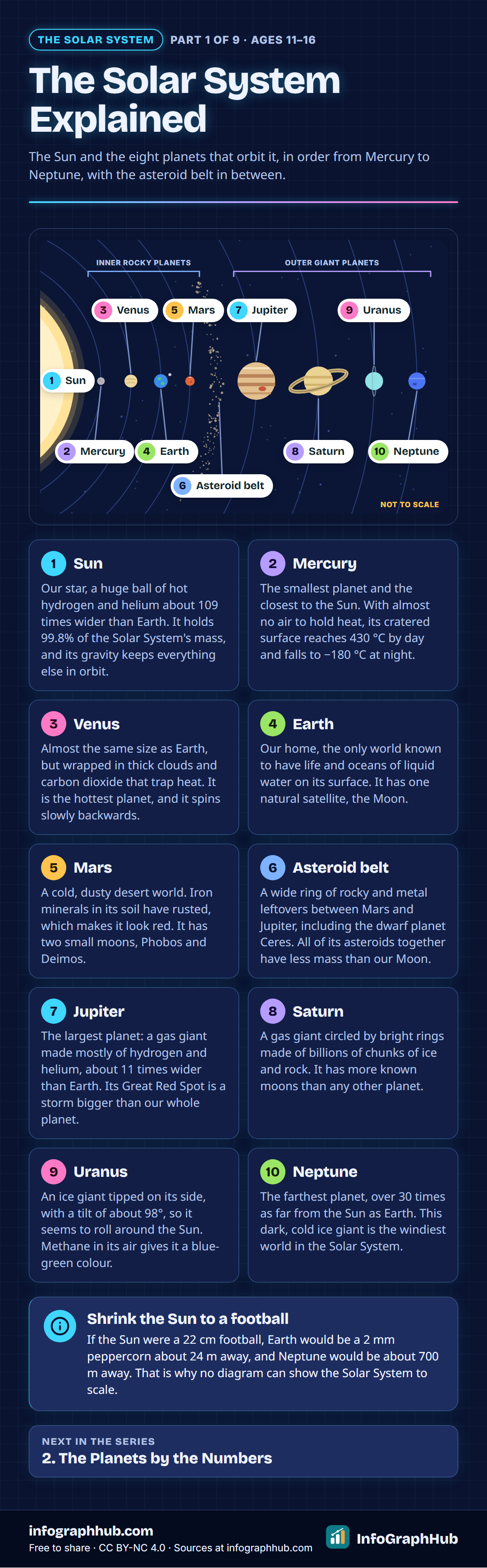
10 labelled parts: Sun → Mercury → Venus → Earth → Mars → Asteroid belt → Jupiter → Saturn → Uranus → Neptune. Press play, or choose a number to explore.
Step 1 of 10: Sun
Our star, a huge ball of hot hydrogen and helium about 109 times wider than Earth. It holds 99.8% of the Solar System's mass, and its gravity keeps everything else in orbit.
Step 2 of 10: Mercury
The smallest planet and the closest to the Sun. With almost no air to hold heat, its cratered surface reaches 430 °C by day and falls to −180 °C at night.
Step 3 of 10: Venus
Almost the same size as Earth, but wrapped in thick clouds and carbon dioxide that trap heat. It is the hottest planet, and it spins slowly backwards.
Step 4 of 10: Earth
Our home, the only world known to have life and oceans of liquid water on its surface. It has one natural satellite, the Moon.
Step 5 of 10: Mars
A cold, dusty desert world. Iron minerals in its soil have rusted, which makes it look red. It has two small moons, Phobos and Deimos.
Step 6 of 10: Asteroid belt
A wide ring of rocky and metal leftovers between Mars and Jupiter, including the dwarf planet Ceres. All of its asteroids together have less mass than our Moon.
Step 7 of 10: Jupiter
The largest planet: a gas giant made mostly of hydrogen and helium, about 11 times wider than Earth. Its Great Red Spot is a storm bigger than our whole planet.
Step 8 of 10: Saturn
A gas giant circled by bright rings made of billions of chunks of ice and rock. It has more known moons than any other planet.
Step 9 of 10: Uranus
An ice giant tipped on its side, with a tilt of about 98°, so it seems to roll around the Sun. Methane in its air gives it a blue-green colour.
Step 10 of 10: Neptune
The farthest planet, over 30 times as far from the Sun as Earth. This dark, cold ice giant is the windiest world in the Solar System.
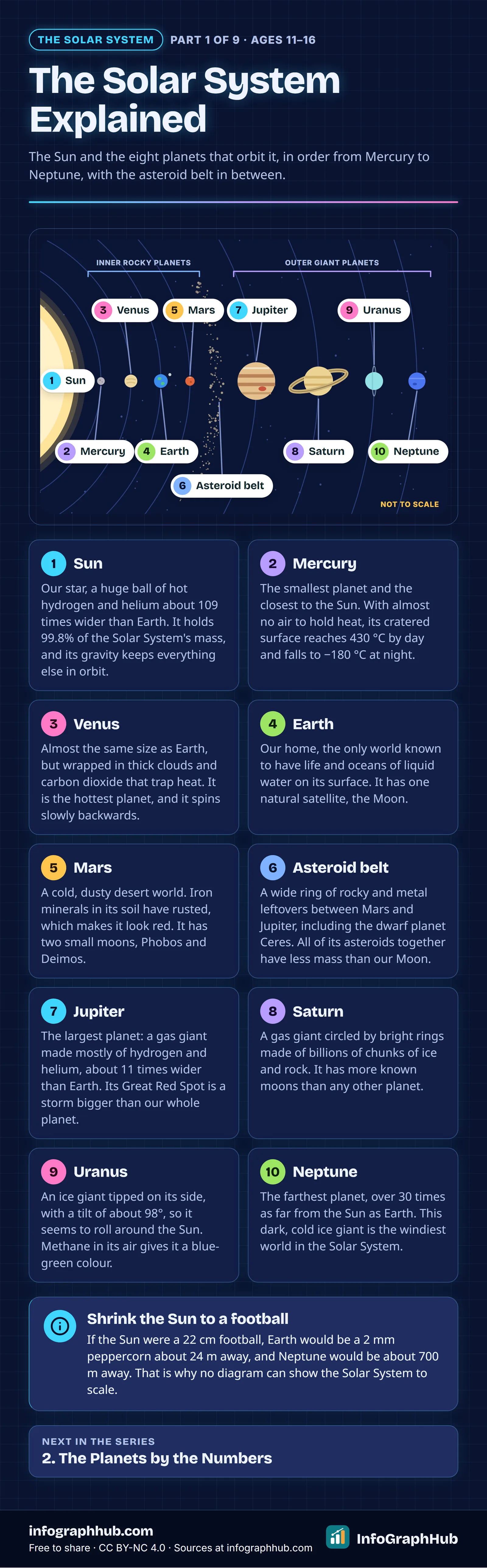
Use this infographic
Free under CC BY-NC 4.0, with credit to InfoGraphHub.
What the Solar System is
The Solar System is our star, the Sun, together with everything that its gravity holds in orbit around it. That includes eight planets, the moons that orbit them, dwarf planets such as Pluto and Ceres, and countless smaller bodies: asteroids, comets and grains of dust. The word solar comes from sol, Latin for 'Sun'.
The Sun is by far the most important member. It holds about 99.8 per cent of all the mass in the Solar System, so everything else, all the planets, moons and asteroids put together, adds up to only about 0.2 per cent. Its gravity is what keeps the whole family together, and its light and heat are what make life on Earth possible.
The eight planets in order
Starting next to the Sun and moving outwards, the planets are:
- Mercury
- Venus
- Earth
- Mars
- Jupiter
- Saturn
- Uranus
- Neptune
A well-known memory aid is My Very Easy Method Just Speeds Up Naming: the first letter of each word matches a planet, in order. You can also invent your own sentence, which often sticks better.
The first four are small, rocky worlds. Between Mars and Jupiter lies the asteroid belt, a wide ring of rocky pieces left over from when the planets formed. Beyond it are the four giant planets: Jupiter and Saturn, the gas giants, and Uranus and Neptune, the ice giants.
What keeps the planets moving
Each planet travels around the Sun on a path called an orbit. The Sun's gravity pulls each planet towards it, while the planet's own speed carries it forwards. The result is a curved path that keeps going round, without the planet either falling into the Sun or flying away into space.
The orbits are nearly circular, and they all lie close to one flat plane, a bit like tracks drawn on a huge disc. All eight planets also travel around the Sun in the same direction. Both patterns are clues to how the Solar System formed, from a single flat, spinning disc of gas and dust.
The closer a planet is to the Sun, the faster it moves and the shorter its year. Mercury goes round in 88 days; Neptune takes almost 165 Earth years.
Beyond Neptune
The Solar System does not stop at Neptune. Beyond it lies the Kuiper Belt, a thick, doughnut-shaped region of icy bodies that begins about 30 astronomical units (AU) from the Sun. One AU is Earth's average distance from the Sun, about 150 million kilometres. Pluto is the largest known object in the Kuiper Belt.
Much farther out, NASA describes the Oort Cloud, a vast shell of icy objects thought to stretch from about 5,000 to 100,000 AU. No spacecraft has reached it yet, and no one has seen it directly. Scientists infer it from the paths of comets that fall inwards from very far away.
Why the diagram is not to scale
No page can show the Solar System to scale. Imagine shrinking the Sun to a football about 22 cm across. On that scale:
- Earth would be a peppercorn about 2 mm wide, roughly 24 metres from the ball.
- Jupiter would be a grape about 2 cm wide, about 120 metres away.
- Neptune would be a pea-sized dot about 700 metres away.
The working is simple. The real Sun is about 1.39 million km across, so the scale is 22 cm for every 1.39 million km. Earth is 149.6 million km from the Sun, which is about 108 Sun-widths, and 108 × 22 cm ≈ 24 m. That is why diagrams squeeze the planets together and draw them much larger than they should be. Almost all of the Solar System is empty space.
Frequently asked questions
What are the planets in order from the Sun?
Mercury, Venus, Earth, Mars, Jupiter, Saturn, Uranus and Neptune. The asteroid belt lies between Mars and Jupiter. A common way to remember the order is 'My Very Easy Method Just Speeds Up Naming'.
What is in the Solar System?
The Sun, eight planets, the moons that orbit them, five officially named dwarf planets (Ceres, Pluto, Haumea, Makemake and Eris), millions of asteroids, comets and icy Kuiper Belt objects, plus dust and gas.
What holds the Solar System together?
The Sun's gravity. The Sun contains about 99.8 per cent of the Solar System's mass, so its pull keeps the planets, asteroids and comets moving in orbits around it.
Which is the biggest planet in the Solar System?
Jupiter. It is about 11 times wider than Earth and more than twice as massive as all the other planets put together. Mercury is the smallest planet.

Sources & methodology
Every fact is checked against the sources below. We write original explanations and draw original graphics; no figures are copied from textbooks. Spotted an error? See our corrections policy.
- Our Solar System: Facts (NASA Science, accessed 1 Oct 2026)
- Sun: Facts (NASA Science, accessed 1 Oct 2026)
- Planetary Fact Sheet (Metric) (NASA Goddard Space Flight Center (NSSDCA), accessed 1 Oct 2026)
- Kuiper Belt: Facts (NASA Science, accessed 1 Oct 2026)
- Solar System quick facts (Royal Museums Greenwich, accessed 1 Oct 2026)
Editorial review pending · Updated
Made by the InfoGraphHub editorial team (how we research and check: editorial and AI policy). First published 2 October 2026, last reviewed 1 October 2026. Found a mistake? Tell the editors.
For teachers: ages and curriculum fit
Ages 11–16 · Grades 6–10 (US) · Years 7–11 (UK) · Classes 6–10 (India)
NGSS is a registered trademark of WestEd. Names and codes are used only to describe curriculum fit; InfoGraphHub is not endorsed by these organisations.
Embed this on your site
Paste this HTML into your page. Keep the credit line: it is required by the CC BY-NC 4.0 license.
Related infographics


For teachers and parents: new InfoGraphHub resources by email
One short email when new free resources go live. For adults (18+) only. No spam, no tracking in emails, unsubscribe anytime.