Science, spaceVisual listPart 4 of 9, The Solar SystemUpdated 1 October 2026
Moons, Dwarf Planets, Asteroids and Comets
The Solar System is far more than the Sun and eight planets. Meet the other kinds of object that orbit the Sun: dwarf planets, moons, asteroids, comets, Kuiper Belt objects and the meteoroids that become shooting stars.
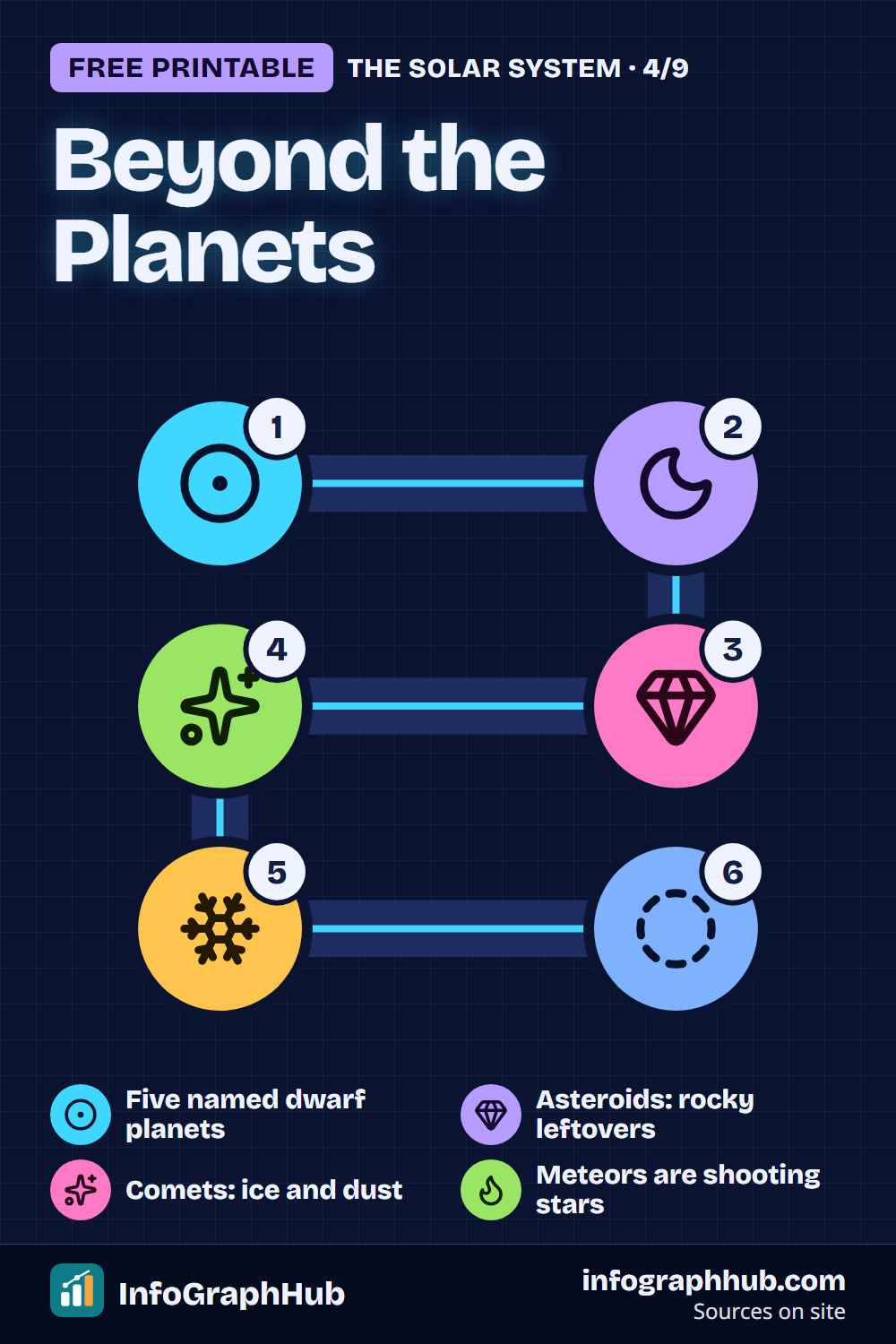
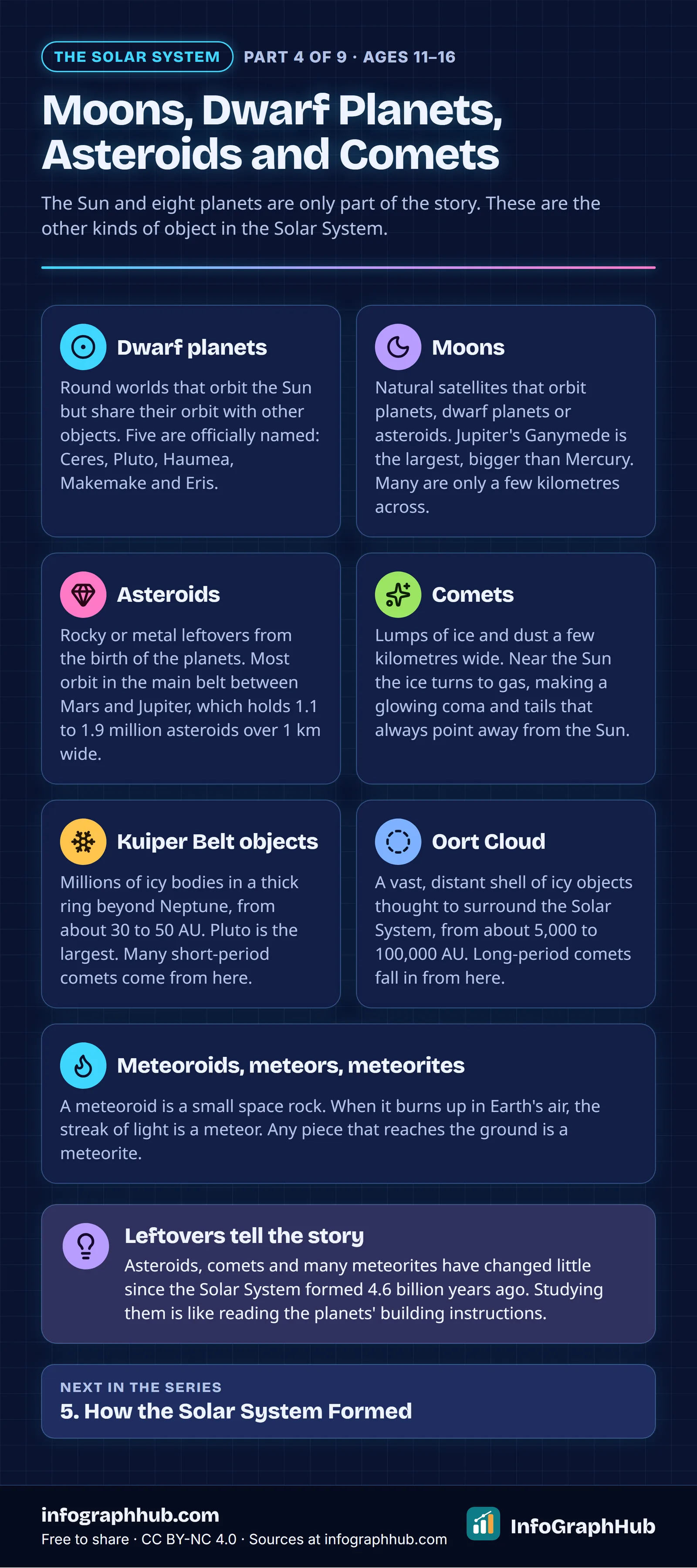
Use this infographic
Free under CC BY-NC 4.0, with credit to InfoGraphHub.
More than planets
Planets get most of the attention, but they are a tiny minority of the objects in the Solar System. NASA counts five officially named dwarf planets, hundreds of moons, more than a million asteroids larger than a kilometre and countless icy bodies beyond Neptune. Most of these smaller objects are leftovers from the cloud of gas and dust that formed the planets about 4.6 billion years ago. Because many have changed little since then, scientists study them to find out what the young Solar System was like.
The International Astronomical Union (IAU) sorts the bodies that orbit the Sun into three classes: planets, dwarf planets and small Solar System bodies, which covers most asteroids, comets and icy objects beyond Neptune. Moons are counted separately, because they orbit something other than the Sun.
Dwarf planets
A dwarf planet orbits the Sun and is massive enough for its gravity to pull it into a nearly round shape, but it shares its orbit with many other objects. In order of distance from the Sun, NASA lists five officially recognised dwarf planets: Ceres, Pluto, Haumea, Makemake and Eris. Ceres is the only one in the inner Solar System; it lives in the asteroid belt and makes up about a quarter of the belt's mass. The others are far beyond Neptune. Astronomers expect many more to be identified, perhaps more than a hundred.
Moons
A moon, or natural satellite, is a natural body that orbits a planet, a dwarf planet or even an asteroid. Moons come in every size. Jupiter's Ganymede is the largest in the Solar System, bigger than the planet Mercury. Many others are only a few kilometres across: rocks captured by a giant planet's gravity.
Some moons are worlds of their own. Saturn's moon Titan has a thick atmosphere, and probes have landed on it. Several icy moons, such as Jupiter's Europa, are thought to have oceans of liquid water hidden beneath their frozen crusts.
Asteroids and the asteroid belt
Asteroids are rocky or metal leftovers. Most orbit in the main asteroid belt between Mars and Jupiter, which NASA estimates holds between 1.1 and 1.9 million asteroids larger than 1 km across, plus millions of smaller ones. The largest asteroid, Vesta, is about 530 km wide. Some asteroids even have small moons of their own.
Asteroids come in three main types: dark carbon-rich ones made of clay and silicate rock, stony ones of silicate rock and nickel-iron, and metallic ones of nickel-iron. Together, all the asteroids in the main belt have less mass than our Moon.
Comets, the Kuiper Belt and the Oort Cloud
A comet is a lump of ice and dust, typically a few kilometres across, coated with dark material. Far from the Sun it is frozen and dark. As it swings closer, sunlight warms the ice, which turns into gas and releases dust. This forms a glowing cloud around the nucleus, the coma, which can be hundreds of thousands of kilometres wide. Sunlight and the solar wind push dust and gas out of the coma into two long tails, one of dust and one of gas, which always point away from the Sun.
Comets come from two cold reservoirs. Short-period comets, which take less than 200 years to orbit the Sun, mostly come from the Kuiper Belt, a thick ring of icy bodies beyond Neptune, from about 30 to 50 AU. Pluto is its largest known member. Long-period comets can take thousands or even millions of years to complete an orbit; they fall in from the distant Oort Cloud.
Meteoroids, meteors and meteorites
These three words describe the same space rock at different stages.
- A meteoroid is a small rock in space, from a grain of dust to a small asteroid. Most are broken pieces of asteroids or dust from comets.
- A meteor is the streak of light you see when a meteoroid rushes into Earth's atmosphere and burns up, often called a shooting star.
- A meteorite is a piece that survives the fall and reaches the ground.
Many meteor showers happen every year at the same time, when Earth passes through a trail of dusty debris left behind by a comet.
Frequently asked questions
What are the five dwarf planets?
In order of distance from the Sun: Ceres, Pluto, Haumea, Makemake and Eris. Ceres is in the asteroid belt; the other four are beyond Neptune. Astronomers think many more are waiting to be recognised.
What is the difference between an asteroid and a comet?
Asteroids are mostly rock and metal and orbit mainly between Mars and Jupiter. Comets are mostly ice and dust from the cold outer Solar System, and they grow a glowing coma and tails when they come close to the Sun.
What is the difference between a meteor and a meteorite?
A meteor is the flash of light made when a small space rock burns up in Earth's atmosphere. A meteorite is a piece of that rock that survives the trip and lands on the ground.
What is the largest moon in the Solar System?
Jupiter's moon Ganymede. It is bigger than the planet Mercury and the dwarf planet Pluto, and it is the only moon known to have its own magnetic field.
Sources & methodology
Every fact is checked against the sources below. We write original explanations and draw original graphics; no figures are copied from textbooks. Spotted an error? See our corrections policy.
- Dwarf Planets (NASA Science, accessed 1 Oct 2026)
- Asteroids: Facts (NASA Science, accessed 1 Oct 2026)
- Comets: Facts (NASA Science, accessed 1 Oct 2026)
- Kuiper Belt: Facts (NASA Science, accessed 1 Oct 2026)
- Meteors and Meteorites: Facts (NASA Science, accessed 1 Oct 2026)
- Ganymede (NASA Science, accessed 1 Oct 2026)
- Resolution B5: Definition of a Planet in the Solar System (International Astronomical Union (IAU), accessed 1 Oct 2026)
Editorial review pending · Updated
Made by the InfoGraphHub editorial team (how we research and check: editorial and AI policy). First published 2 October 2026, last reviewed 1 October 2026. Found a mistake? Tell the editors.
For teachers: ages and curriculum fit
Ages 11–16 · Grades 6–10 (US) · Years 7–11 (UK) · Classes 6–10 (India)
NGSS is a registered trademark of WestEd. Names and codes are used only to describe curriculum fit; InfoGraphHub is not endorsed by these organisations.
Embed this on your site
Paste this HTML into your page. Keep the credit line: it is required by the CC BY-NC 4.0 license.
Related infographics


For teachers and parents: new InfoGraphHub resources by email
One short email when new free resources go live. For adults (18+) only. No spam, no tracking in emails, unsubscribe anytime.