Ratio and Proportion: Cheat Sheet with Worked Examples
A one-page ratio and proportion cheat sheet: write and simplify ratios, tell a ratio from a fraction, share an amount in a ratio, use unit rates to find the best buy, solve direct proportion problems and read scales on drawings and maps.
Ages 11–14 · Grades 6–8 (US) · Years 7–9 (UK) · Classes 6–8 (India)
- Common Core Math 6.RP.A.1
- Common Core Math 6.RP.A.3
- Common Core Math 7.RP.A.2
- England KS3 Years 7–9
- AQA GCSE R5
- Cambridge IGCSE 0580 C1.11 / E1.11
- Australian Curriculum v9 AC9M7N08
- Australian Curriculum v9 AC9M8M05
- CBSE Class 8
Cambridge and IGCSE are trademarks of Cambridge University Press & Assessment. Common Core State Standards © Copyright 2010 National Governors Association Center for Best Practices and Council of Chief State School Officers. All rights reserved. Names and codes are used only to describe curriculum fit; InfoGraphHub is not endorsed by these organisations.
What a ratio is
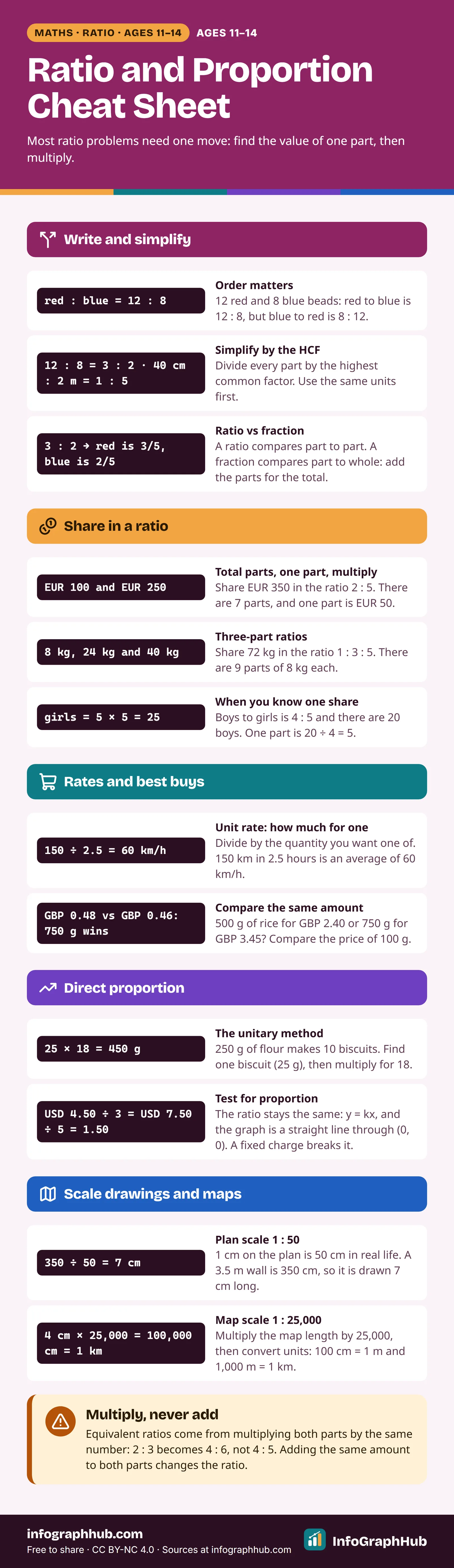
A ratio compares the sizes of two or more quantities. A bag with 12 red beads and 8 blue beads has a red-to-blue ratio of 12 : 8. The order of the words gives the order of the numbers, so blue to red is 8 : 12.
A ratio is not a fraction. The ratio 3 : 2 compares one part with another; the matching fractions compare each part with the whole. With 3 red beads for every 2 blue, there are 5 beads in each group, so red beads are 3/5 of the total and blue beads 2/5.
Simplifying ratios
To write a ratio in its simplest form, divide every part by the highest common factor (HCF). 12 : 8 divides by 4 to give 3 : 2, and 18 : 24 divides by 6 to give 3 : 4.
Two extra checks: put every part in the same unit before simplifying, so 40 cm : 2 m becomes 40 : 200 = 1 : 5; and clear decimals by multiplying, so 1.5 : 2 becomes 3 : 4.
Sharing an amount in a ratio
Use three steps: add the parts, find the value of one part, then multiply.
- Share EUR 350 in the ratio 2 : 5. Total parts: 2 + 5 = 7.
- One part: 350 ÷ 7 = EUR 50.
- Shares: 2 × 50 = EUR 100 and 5 × 50 = EUR 250. Check: 100 + 250 = 350.
The method works for three-part ratios too: 72 kg in the ratio 1 : 3 : 5 is 9 parts of 8 kg, giving 8 kg, 24 kg and 40 kg. If you know one share instead of the total, find one part from that share: with boys to girls 4 : 5 and 20 boys, one part is 5, so there are 25 girls.
Unit rates and best buys
A unit rate is the amount for one unit of something: kilometres per hour, price per kilogram, pay per hour. Find it by dividing by the quantity you want one of. A car covering 150 km in 2.5 hours averages 150 ÷ 2.5 = 60 km/h.
To find the best buy, compare the price of the same amount. A 500 g bag of rice for GBP 2.40 costs GBP 0.48 per 100 g; a 750 g bag for GBP 3.45 costs GBP 0.46 per 100 g. The larger bag is better value, as long as you use it all.
Direct proportion
Two quantities are in direct proportion when they change by the same factor: double one and the other doubles. The ratio between them stays the same, so they fit y = kx, where k is the unit rate, and their graph is a straight line through the origin.
If 250 g of flour makes 10 biscuits, one biscuit needs 25 g, so 18 biscuits need 450 g. Notebooks at USD 1.50 each are proportional: 3 cost USD 4.50 and 5 cost USD 7.50. A taxi with a fixed EUR 3 charge plus EUR 2 per km is not: 1 km costs EUR 5, but 2 km cost EUR 7, not EUR 10.
Scale drawings and maps
A scale is a ratio between a length on a drawing and the real length, in the same unit. On a plan at 1 : 50, a 3.5 m wall (350 cm) is drawn 350 ÷ 50 = 7 cm long. On a map at 1 : 25,000, 4 cm stands for 4 × 25,000 = 100,000 cm, which is 1,000 m or 1 km. Most mistakes happen in the final unit conversion, so write each step.
Frequently asked questions
How do you simplify a ratio?
Divide every part by the highest common factor. For 18 : 24 the HCF is 6, so the simplest form is 3 : 4. Convert to the same units and clear any decimals first.
How do you share an amount in a given ratio?
Add the parts of the ratio, divide the amount by that total to find one part, then multiply by each number in the ratio. EUR 350 in the ratio 2 : 5 gives 7 parts of EUR 50, so EUR 100 and EUR 250.
What is the difference between a ratio and a proportion?
A ratio compares two or more quantities, such as 3 : 2. A proportion says two ratios are equal, such as 3 : 2 = 6 : 4. Two quantities are in direct proportion when their ratio stays the same as they change.
How do you use a map scale?
Multiply the length on the map by the scale number to get the real length in the same unit, then convert. At 1 : 25,000, 4 cm on the map is 100,000 cm in real life, which is 1 km.
Sources & methodology
Every fact is checked against the sources below. We write original explanations and draw original graphics; no figures are copied from textbooks. Spotted an error? See our corrections policy.
- Prealgebra 2e, 5.6 Ratios and Rate (OpenStax (Rice University), accessed 1 Oct 2026)
- Prealgebra 2e, 6.5 Solve Proportions and their Applications (OpenStax (Rice University), accessed 1 Oct 2026)
- Grade 6, Unit 2: Introducing Ratios (Illustrative Mathematics (Kendall Hunt), accessed 1 Oct 2026)
- Grade 7, Unit 2: Introducing Proportional Relationships (Illustrative Mathematics (Kendall Hunt), accessed 1 Oct 2026)
Editorial review pending · Updated
Embed this on your site
Paste this HTML into your page. Keep the credit line: it is required by the CC BY-NC 4.0 license.
Related infographics
 Data
DataPercentages Explained: Cheat Sheet with Worked Examples
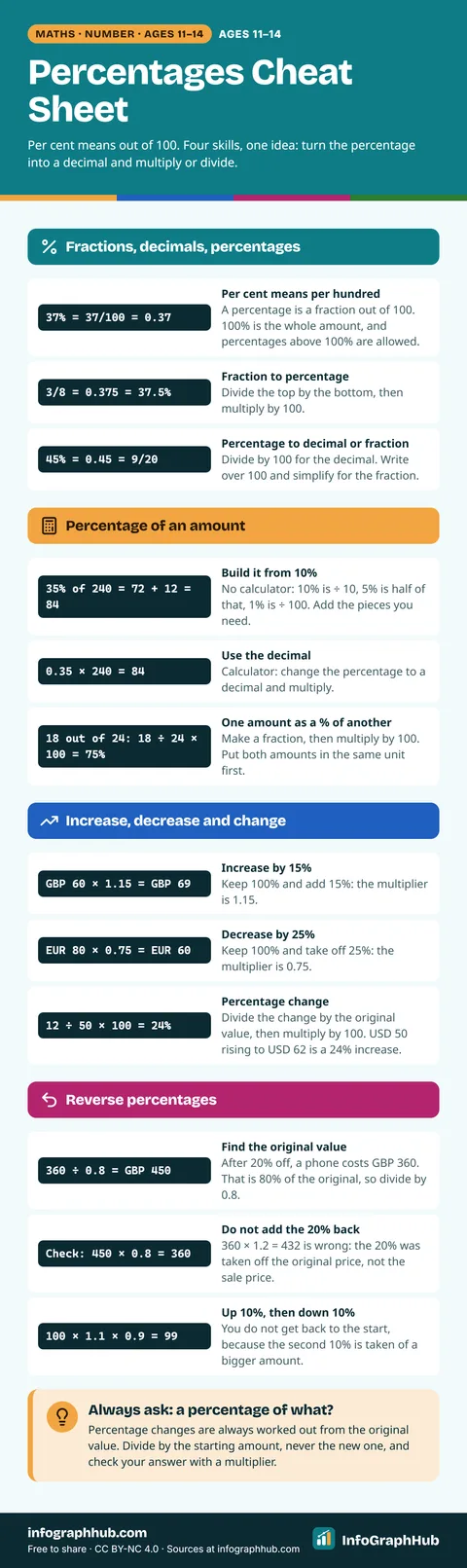
A one-page percentages cheat sheet: convert fractions, decimals and percentages, find a percentage of an amount, increase and decrease with a multiplier, work out a percentage change and solve reverse percentage problems, each with a worked example.
 Finance
Compound Interest Explained: How Money Grows Over Time
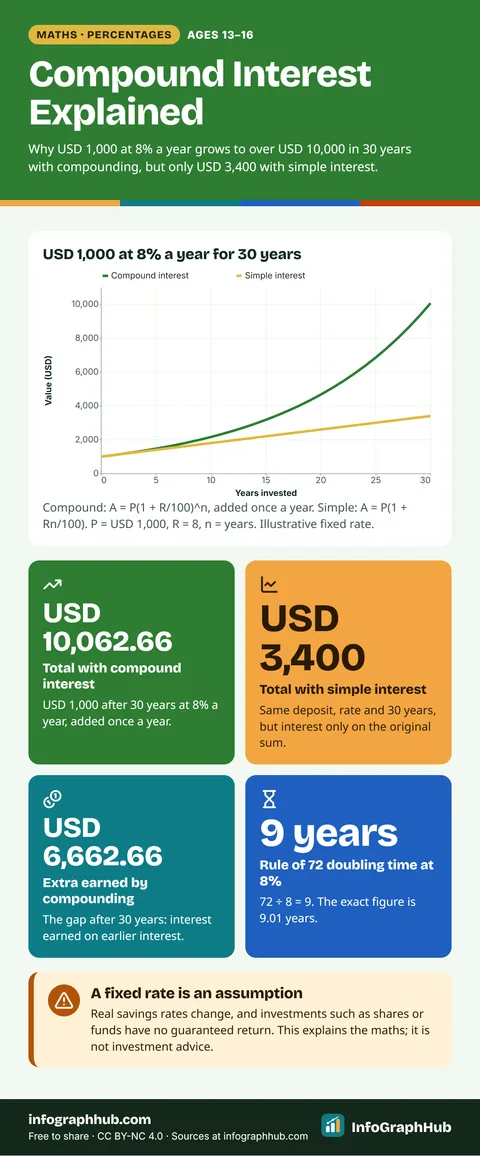
Compound interest is interest earned on interest. Each year’s interest is added to the balance, so the next year’s interest is worked out on a bigger sum. That makes money grow exponentially, far faster than the straight-line growth of simple interest.
 Finance
Credit Scores in India: How They Work and Your RBI Rights
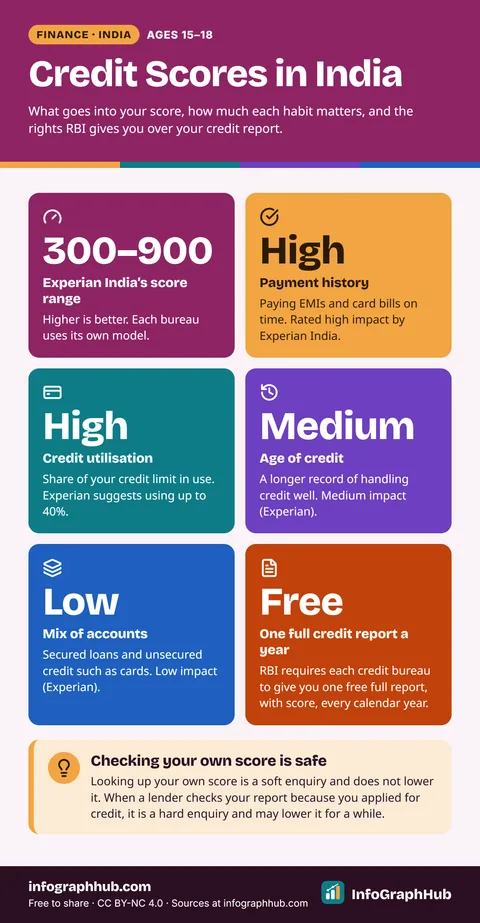
A credit score is a three-digit number, such as Experian India’s 300–900 score, built from your borrowing record. Paying on time and using little of your credit limit matter most; the age and mix of your accounts matter less.
 Tech
TechGit Commands Cheat Sheet: The Essentials for Beginners
The Git commands beginners use most: set up a repository with init or clone, save work with add and commit, build features on branches with switch and merge, share work with fetch, pull and push, and undo safely with restore.
 Finance
How Credit Scores Work: What Moves Your Score
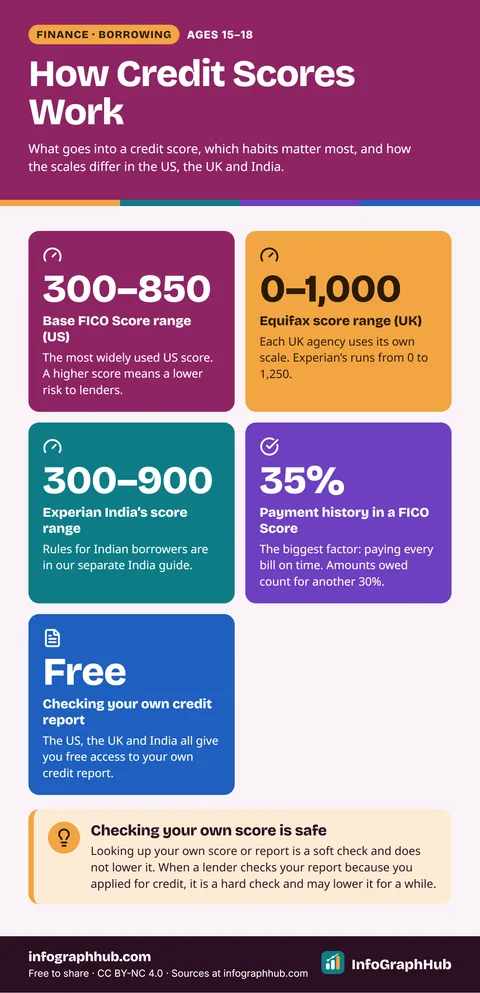
A credit score is a number that predicts how likely you are to repay borrowing on time, built from your credit report. Paying on time and using little of your credit limit matter most. Each country, and each agency, uses its own scale.
 Tech
TechHow Large Language Models Work: From Prompt to Answer
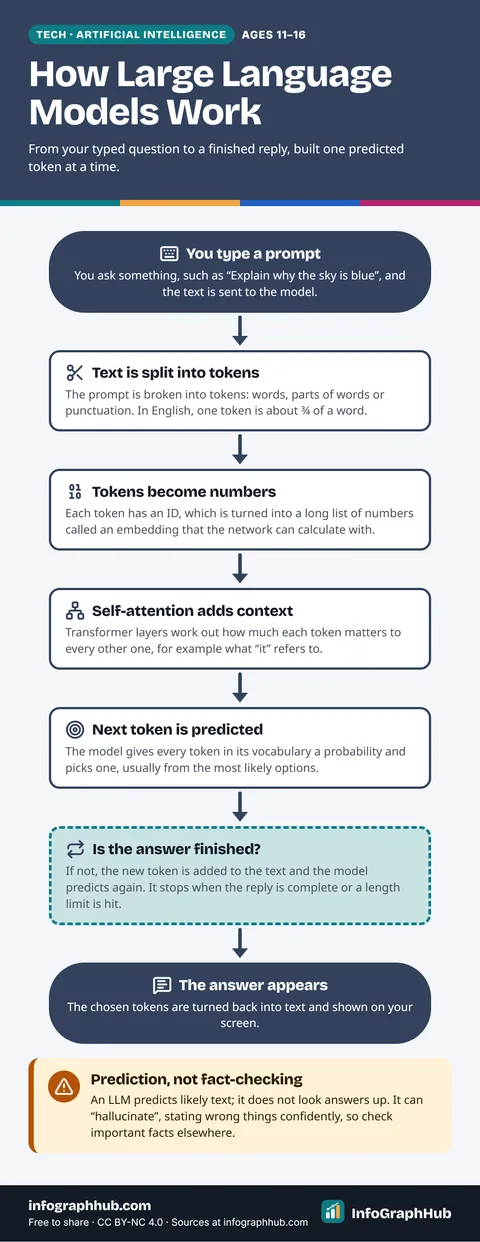
A large language model splits your prompt into tokens, turns them into numbers, uses self-attention to work out context, then predicts the most likely next token. It repeats that prediction, one token at a time, until the answer is complete.
For teachers and parents: new InfoGraphHub resources by email
One short email when new free resources go live. For adults (18+) only. No spam, no tracking in emails, unsubscribe anytime.